The most notable AI news tonight is not about new models or chips.
It’s this:
Google is locking in electricity supply for AI for more than 20 years.
Today, Google announced:
Over the next two years, it will invest at least:
€13 billion
The funds will go toward:
Data centers,
AI infrastructure,
Power grids,
Clean energy,
Batteries,
and other supporting infrastructure.
Google says this is its largest single investment in Europe to date.
But the real focus should be on a different deal:
A 22-year agreement.
Google’s First Long-Term Nuclear Power Deal Outside the US
Google has signed a long-term Power Purchase Agreement (PPA) with Finnish energy company Fortum.
A PPA is a:
Power purchase agreement.
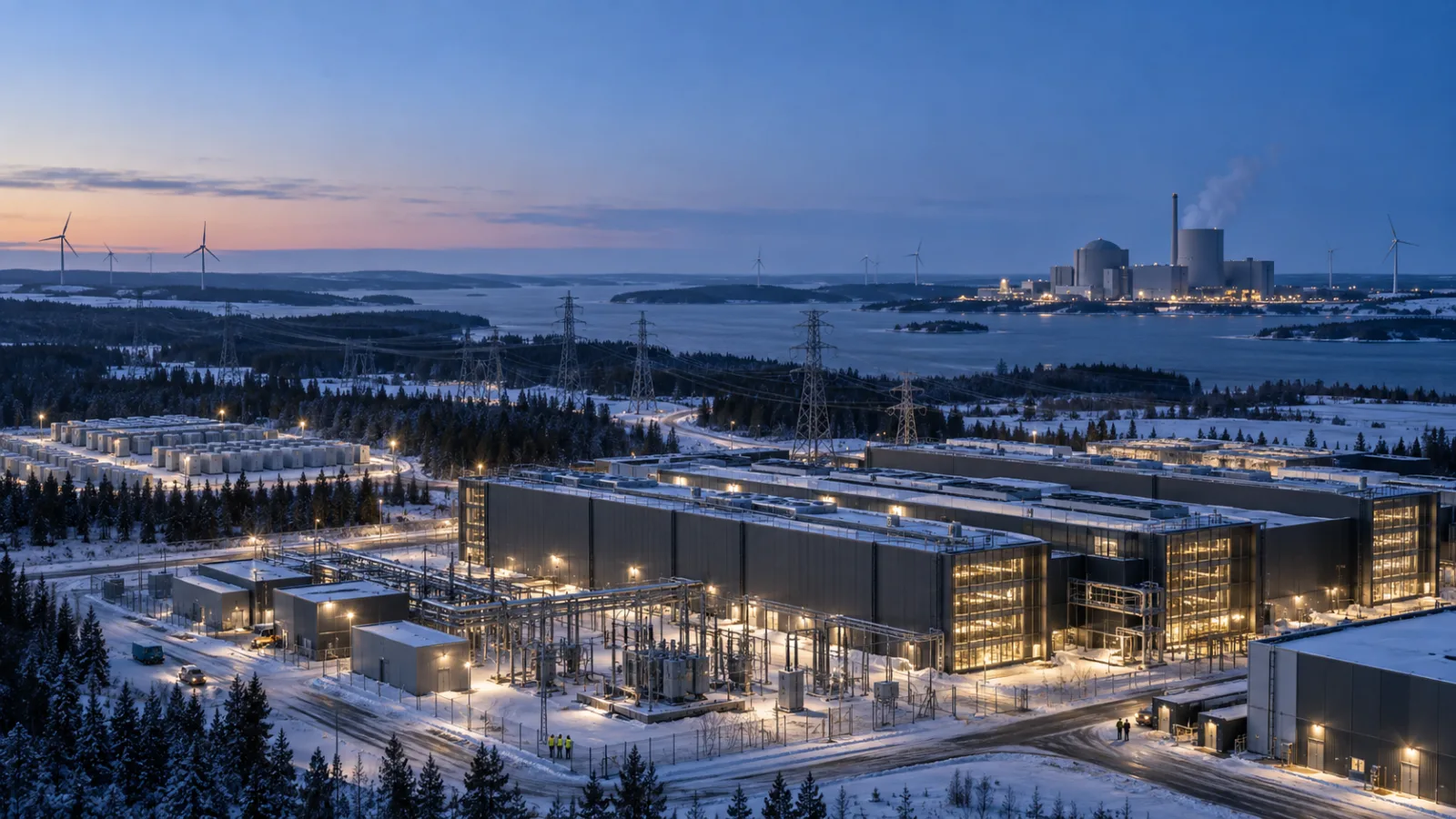
This agreement concerns the Finnish Loviisa nuclear power plant.
Fortum explained:
The agreement will start at a smaller scale in 2028.
From 2030 to 2049, Google can purchase up to:
50% of Loviisa’s capacity.
And this contract lasts a full:
22 years.
Reuters notes this is Google’s first nuclear-related PPA outside the US.
This means Google isn’t just buying electricity for a year or two;
it’s planning its energy strategy all the way out to:
2050.
Why Is Google Willing to Sign a 22-Year Deal?
AI data centers face a very practical challenge:
They can’t only run when:
There’s sun,
There’s wind,
Or electricity prices are low.
AI servers often need to operate:
24 hours,
All year round,
Continuously,
Especially for large services like Search, Maps, YouTube, Gemini, and Cloud.
The real requirement is not:
“Generating a lot of electricity on average per year.”
But:
Having electricity available exactly when needed.
Nuclear power’s appeal lies here.
It provides long-term stable electricity generation,
And relatively low carbon emissions.
As tech companies’ AI power demands grow,
nuclear power is becoming an important option for large data centers again.
Google Is Not Buying the Nuclear Plant
This number can be easily misunderstood.
Google is not:
Buying Loviisa outright,
Nor immediately taking half of its total output.
More precisely:
Google is signing a long-term electricity purchase agreement with Fortum.
Following the agreement’s timeline,
Starting in 2028,
Reaching up to:
50% of the nuclear plant’s capacity after 2030.
Google’s long-term purchase guarantees a stable revenue stream,
While Fortum uses this revenue certainty to support investments in extending the plant’s life and upgrades.
This is a form of:
Energy consumers and producers locking in future risks together.
The Deal Even Affects Whether the Nuclear Plant Can Keep Operating
Fortum was very straightforward.
Without life extension investments,
Loviisa could not continue operating at its current scale beyond 2030.
Fortum is currently undertaking about:
€1 billion in life extension investments.
The goal is to run the plant until:
2050.
Fortum states there’s still roughly €700 million in capital expenditures pending further investment decisions.
Google’s long-term contract provides revenue certainty to support these future investments.
Meaning,
Google isn’t just buying existing electricity on the market.
Its long-term AI power needs are already influencing whether an existing power plant should continue investing in its future.
Loviisa Currently Supplies About 10% of Finland’s Electricity
This is why this issue is not just about Google alone.
Fortum says Loviisa currently supplies roughly:
10% of Finland's electricity.
The plant employs about:
580 people.
This raises questions:
If large AI companies lock in large amounts of power,
What happens to households and businesses?
This is one of the most sensitive current issues for AI data centers.
If tech companies significantly increase power demand,
Are they:
Taking away existing power,
Or creating new power supply together?
Google and Fortum emphasize that one goal of this long-term partnership is to ensure new AI demands don’t just become extra pressure on the existing power grid.
So Google Is Not Just Buying Nuclear Power
Today’s energy strategy is not:
Going all-in on nuclear.
Google also announced plans to continue expanding its onshore wind power procurement in Finland.
According to Google,
The newly contracted onshore wind power capacity in Finland will total:
629MW.
They will also build a:
94MW battery system,
Expected to start operating near the end of 2027.
The battery’s role isn’t to power the entire AI data center continuously,
But to help absorb and release electricity when:
Wind is insufficient,
Sudden increases in demand occur,
Or the grid requires balancing.
Even "Using Less Power Sometimes" Becomes an Energy Tool
Google also highlighted another important concept:
Demand Response.
This means that when the grid is under extreme stress,
Data centers do not always insist,
“Give me all the power I want.”
Some workloads that can be delayed or adjusted might temporarily reduce power consumption.
Google has already tested this approach at its Hamina data center in Finland.
Now it plans to continue researching with grid operators:
Whether AI data centers can become more flexible power consumers.
This is very important.
If AI data centers grow massively,
They can’t always expect power plants to adjust on their own.
Data centers themselves must also:
Adapt to the grid.
Why Has Finland Suddenly Become a Popular AI Data Center Location?
Finland has several unique advantages.
First:
High proportion of low-carbon electricity.
It has nuclear power,
And abundant renewable energy.
Second:
Cold climate.
One of the biggest costs in data centers is cooling.
Servers generate heat as they operate.
In naturally cold places,
Cooling energy demand can be reduced.
Google’s Hamina data center in Finland even uses seawater cooling.
Third:
Relatively stable power system.
For AI data centers,
These factors can be even more important than:
Cheap land.
Where Exactly Is Google Spending the €13 Billion?
Google says from 2027 to 2028, it will increase investments in Hamina, Kajaani, Muhos, and Vaala.
This will include:
New data centers,
Digital infrastructure,
Energy projects,
Grid infrastructure,
Batteries,
And local partnerships.
These facilities will support services like:
Gemini,
Search,
Maps,
YouTube,
And other Google digital services.
So this €13 billion investment is not just about:
“Spending €13 billion only to train Gemini.”
It’s a comprehensive:
AI + cloud + energy + grid + data center infrastructure investment.
What Economic Benefits Does Google Claim for Finland?
Google estimates that during initial construction phases in 2027 and early 2028,
The activities will support over:
37,000 jobs
In Finland and contribute about:
€3.6 billion annually to Finland’s GDP.
Google also states:
Once these new facilities are fully operational, they will continue to support thousands of permanent jobs.
But all this should be marked clearly as:
Google’s own estimated economic impact,
Not actual finalized statistics from Finland,
Since most investments have yet to be completed.
The AI Bottleneck Is Expanding Beyond GPUs
Over the past year, the most common issues heard are:
GPU shortages (Nvidia),
Memory shortages (HBM),
Data center shortages.
But when these get built at scale,
The next challenges naturally emerge:
Where will the power come from?
And further:
Is the grid sufficient?
Are substations enough?
Are transmission lines enough?
Can data centers connect?
Will electricity prices rise?
Is the energy low-carbon?
Should companies build new power plants?
AI infrastructure now forms a long chain that spans:
Chips → Servers → Data Centers → Power Grids → Power Generation.
The AI model’s output is just one part of a physical industrial system.
Why Is the 22-Year Deal More Important Than €13 Billion?
€13 billion is huge.
Tech companies may announce larger annual investments regularly.
The real difference is the:
22-year deal.
An AI company willing to sign such a long energy contract means its expectations for future computing demand go beyond:
“AI is popular this year or two.”
It plans with:
Nuclear plants,
Batteries,
Wind power,
Grids,
And other multi-decade infrastructure.
This isn’t typical software investment anymore.
It increasingly resembles:
Steel, semiconductor, petrochemical, and large manufacturing industries,
Which prepare capacity years in advance.
This Doesn’t Mean Nuclear Is the Only Answer for AI
We shouldn’t read this news as:
“AI must rely solely on nuclear power in the future.”
Google itself uses diverse energy sources,
Including nuclear,
Wind,
Batteries,
Demand response,
And other grid solutions.
Different countries have:
Different energy mixes,
Different laws,
Different geography,
Different grid constraints.
The real trend isn’t:
That all AI data centers must build nuclear plants nearby,
But that:
AI companies will need to be responsible for securing their future power supply.
They can’t just:
Buy GPUs,
Build servers,
And assume the grid will supply unlimited electricity.
How Does This Affect the Average Person?
You may never sign a 22-year nuclear deal.
But this has three direct implications:
First:
AI pricing.
Electricity will become an increasingly important part of AI computing costs.
If energy is expensive,
AI services can’t endlessly rely on model price reductions to offset costs.
Second:
Whether your area becomes a data center hub.
Data centers bring:
Investment,
Jobs,
Tax revenue,
But also require:
Land,
Power,
Transmission,
Cooling,
So local governments have to balance these factors.
Third:
Future discussions on AI and environmental impact can’t just focus on model efficiency.
They must consider:
Where the power comes from,
How data centers are cooled,
Whether new power plants are needed,
And if costs are passed to consumers.
The Next AI Battle May Be ”Who Secures Electricity First”
The strongest AI companies will eventually get chips.
What may be even harder to scale rapidly are:
Power plants,
Substations,
Transmission lines,
Grid capacity,
Land.
Nuclear plant life extensions can’t be decided today and be operational immediately.
Google signing a 22-year deal now reveals a simple reality:
The truly scarce AI resource may not just be the most advanced GPU,
But the electricity to power that GPU
Continuously, every hour, for 20 years.
When AI companies plan their computing capacity based on nuclear plant lifespans,
AI competition is no longer just a tech industry story;
It officially involves:
Energy,
Grids,
Cities,
And national long-term infrastructure.
Today, progress with AI a little bit each day.
Learn one AI skill daily.
Save a little time daily.
Grow incrementally every day.
SasaDaily, growing together with you.
Recommended Reading
Why You Didn't Buy AI but May End Up Paying for It in Your Electricity Bill