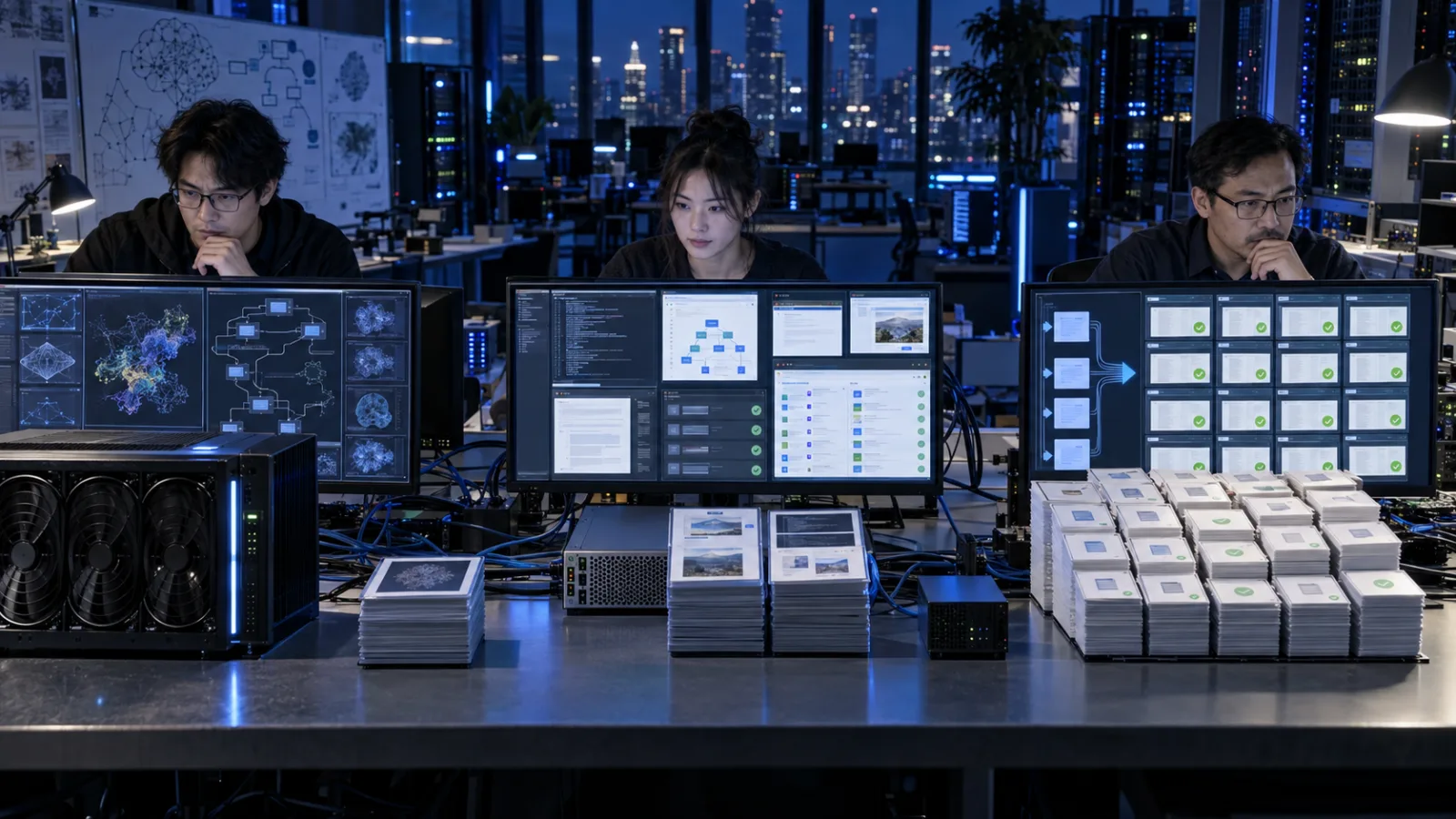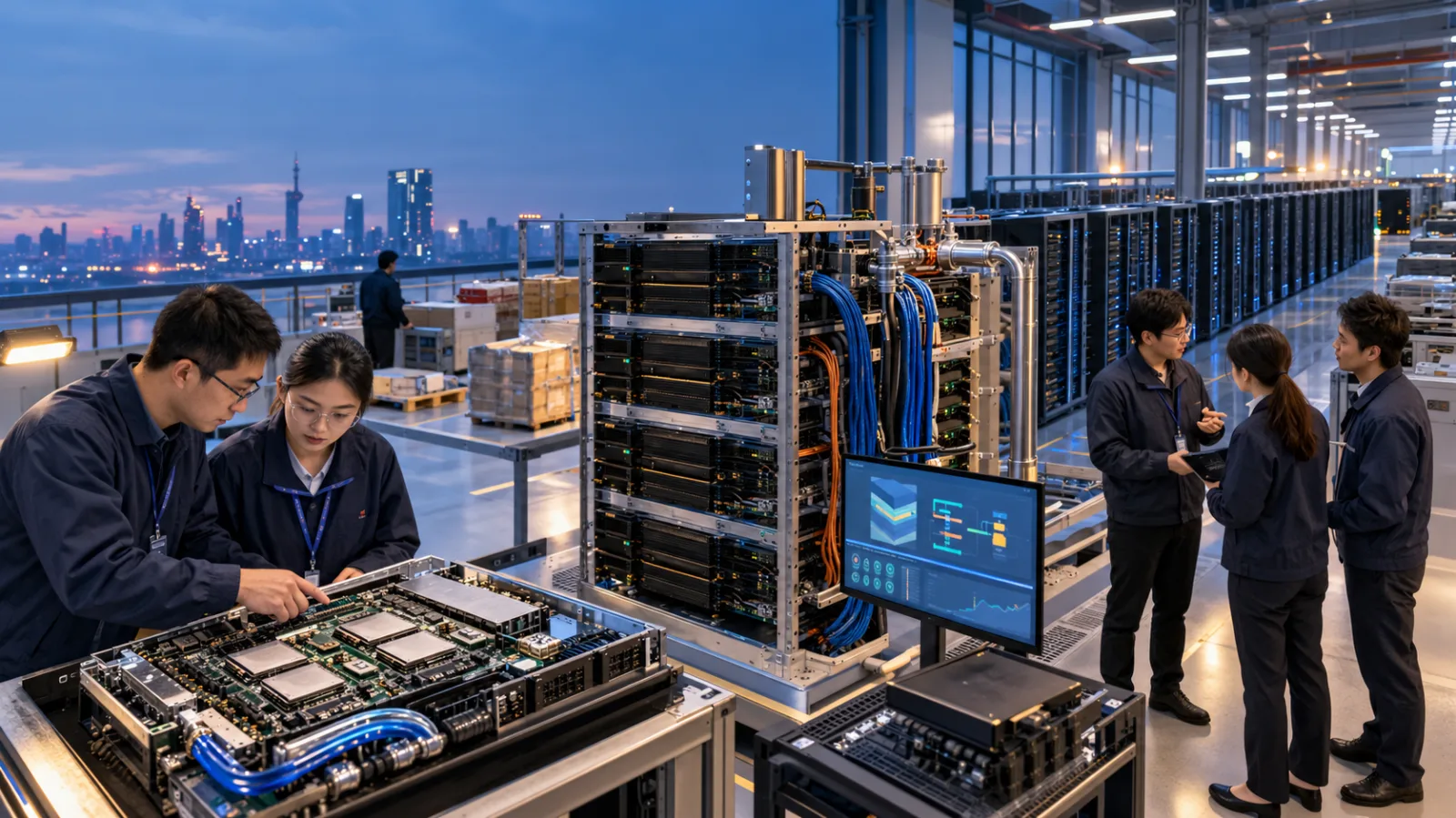
AI chip competition:
In the past, the easiest way to understand it was:
Take two chips:
Compare.
Who:
calculates faster?
Who:
uses less power?
Who has:
greater memory bandwidth?
Today:
Huawei provides a:
very different answer.
If:
a single chip:
is not the strongest,
then:
don’t just compare single chips.
Connect:
more chips,
memory,
networks,
and optical interconnects,
all into:
a bigger machine.
Huawei acknowledges a very real problem today: AI computing power is in short supply
On September 17:
Huawei Connect was held in Shanghai.
Huawei Rotating Chairman Xu Zhijun said in an interview:
Currently, Huawei’s own:
AI computing products
cannot even meet demand within China.
Therefore,
the company cannot fully expand the
international market.
It’s not that:
overseas customers don’t want them,
but rather:
domestic orders can’t be fulfilled.
Huawei currently supplies limited overseas markets
Xu said:
For some countries with especially strong demand,
Huawei will continue to supply,
but in limited quantities.
This is important.
For years, one of the biggest questions about Chinese AI chips was:
“Is anyone really using them?”
Now Huawei faces the opposite issue:
“There is demand, but can production keep up?”
Huawei believes Ascend may already have passed Nvidia in China’s AI chip market
Xu stated that China’s AI chip market:
lacks reliable market share data,
but he personally thinks:
Ascend
may already be ahead of Nvidia in China.
This statement: should be approached cautiously,
as Huawei has not provided public data to prove it.
So, it’s inaccurate to say:
“Huawei has officially surpassed Nvidia.”
A more precise description is:
This is Huawei management’s personal judgment.
One thing is clearer: China’s AI computing power is rapidly shifting to domestic systems
The reason:
is not just the products themselves,
but also U.S. export restrictions.
Chinese companies can no longer freely access Nvidia’s most advanced AI accelerators,
and some advanced semiconductor equipment is also restricted.
Thus, China is not just looking to develop its own AI chips,
but must rebuild the full chain of
models, chips, memory, interconnects, software, and data centers.
This explains why Huawei keeps emphasizing “self-reliance” today
Xu directly linked AI chips to supply independence.
His message is clear:
China does not want future access to AI computing power
to depend on whether foreign companies are willing
to sell the chips.
It’s not just
a chip issue,
but about control over the entire AI infrastructure.
The first real product focus is Ascend 950DT
Huawei stated:
The 950DT has shown good test results so far.
The company is already holding broad discussions
with multiple Chinese AI model developers.
Huawei expects that by 2027,
more developers will begin to use the 950DT system directly for model training.
Why this is notable: training is harder than inference
Inference means:
using a pre-trained model to answer questions,
generate images, or write code.
Training means:
actually building a large model.
It demands higher levels of
compute, memory, interconnect, software, and reliability.
If many Chinese models truly start training directly on Ascend,
it signifies the ecosystem has advanced from
“able to run models” to “able to create models.”
Huawei’s biggest move today was advancing the next-generation chip timeline
Originally, Huawei’s 2025 roadmap scheduled Ascend 960
for release in Q4 2027.
New plans divide it into two versions:
Ascend 960DT
and
Ascend 960PR.
960DT is brought forward the most
Huawei plans to have Ascend 960DT ready by
Q1 2027,
which is three quarters earlier,
roughly 9 months ahead of the original roadmap.
960PR is expected in Q3 2027, one quarter earlier than planned.
Upcoming Ascend 970 and 980
Huawei plans annual new Ascend processors thereafter,
with 970 scheduled for 2028, 980 for 2029.
This establishes a regular yearly upgrade cadence.
This roadmap is important because large data centers don’t
replace all cards yearly; businesses want assurance the next generations will arrive and support continuous upgrades without rewriting software.
Huawei faces a key problem: a single chip can’t keep pace with Nvidia just by process node improvements
Advanced semiconductor process, HBM, packaging, EDA, and manufacturing equipment
all face supply constraints.
Therefore, simply designing a chip stronger than Nvidia’s latest GPU is extremely difficult.
Huawei is adopting a different strategy.
Instead of making every chip the strongest, it’s about getting many chips to work together
This is today’s most important system-level strategy.
Imagine a construction site.
You don’t have the strongest single worker,
but if you can coordinate 4,000, 100,000, or even 1 million compute units
efficiently working together,
total capacity can become very substantial.
The challenge: more chips don’t automatically mean faster processing
This is where AI infrastructure faces real difficulties.
If each of 10,000 chips has to wait for data from others,
adding more chips creates more wasted time.
Huawei estimates traditional large training clusters’ machine-to-machine communication
can consume over 40% of training time.
That means many expensive AI chips are not computing but waiting for data.
The bottleneck becomes interconnect
How chips communicate,
how processors access memory on other machines,
how storage quickly feeds data,
and how networks avoid congestion,
all become critical.
These were rarely worries before but are now key battlegrounds for AI servers.
Huawei officially announced the Ascend 960 SuperNode today
Huawei says the new Ascend 960 SuperNode
can connect up to 4,096 AI processors
into one large computing unit.
Not just 4,096 independent machines,
but designed to work together like one giant machine.
It uses UnifiedBus, called “Lingqu” by Huawei
This architecture connects not only processors but also memory, storage, and network.
The core idea is to make access across physical servers more efficient,
blurring the boundaries between one chip’s memory and another server’s memory.
Today, Huawei also introduced the Hi-ONE NPO optical engine
The Ascend 960 SuperNode uses NPO (Near-Packaged Optics),
which moves high-speed optical communication closer to the compute units.
As AI clusters grow larger, electrical signal distance, power, signal loss, and complexity increase,
so optics get pushed closer to chips and switches.
Huawei claims Ascend 960 SuperNode uses 5,500 Hi-ONE units
These Hi-ONEs replace about 48,000 traditional 800G optical modules
and reduce system power consumption by over 550 kW.
These are claims from Huawei, currently vendor data,
not independently verified by third parties.
The direction is promising
Because today’s AI data centers don’t just lack GPUs, but also face constraints in power, cooling, networks, optics, memory, and real estate.
When placing thousands of power-hungry processors into a supernode,
every watt turned into heat matters.
So, the efficiency of interconnect and power savings directly influence how much computing power data centers can pack in.
An Ascend 960 SuperNode is not the final stage
4,096 processors is already many,
but Huawei aims to connect many supernodes together.
Using Lingqu or RoCE networks, multiple Ascend 960 SuperNodes can form larger clusters.
The first layer’s largest scale is 512,000 cards
With multi-rail topologies, Huawei plans for a maximum system supporting
1 million cards.
One million AI processors working together.
This is a planned architecture and theoretical limit,
not a currently operating million-card data center.
Reuters calls this architecture Peerium
The core goal is the same:
using many processors, high-bandwidth interconnect, unified memory access,
to build a logically larger AI computer.
So Huawei’s competition with Nvidia is no longer just Ascend vs GPUs,
but AI factory vs AI factory.
Why is Nvidia so difficult to displace?
Because Nvidia is not just selling GPUs,
it also owns CUDA, networking, NVLink, switches, server architecture, software libraries, developer tools,
and a complete ecosystem.
That’s why, even if another company has a chip close in benchmark,
businesses do not immediately switch.
The hardest part is often software, not hardware
Developers have been using CUDA for over a decade,
with AI frameworks, libraries, kernels, optimization, debugging tools all built around Nvidia.
This creates a deep moat for Nvidia.
Reuters specifically notes CUDA remains a key Nvidia advantage
Huawei knows that hardware alone is insufficient,
so it is developing CANN, a software stack.
Huawei says CANN is continuously open sourced and open,
to make development easier on Ascend.
Huawei reports over 5,200 monthly active developers
More than 40 AI models have completed training
directly on the Ascend computing platform.
Early Ascend 910C systems have been deployed more than 1,000 times,
and Ascend 950 has started commercial use.
These figures come from Huawei, not third-party market share data.
Returning to today’s real issue: supply shortages
If demand truly exceeds supply,
Huawei’s biggest upcoming problem may not be “will customers buy?”
but rather: “can it produce the chips?”
AI chips require advanced processes, memory, packaging, substrates, optics, cooling, and servers.
Any bottleneck in this supply chain stalls the entire system.
This ties to yesterday’s SK Hynix news
SK Hynix is reportedly discussing with Intel
whether to produce some memory chips in the U.S. for the first time,
driven partly by AI’s heavy HBM demand.
Today, Huawei openly states AI computing product supply is insufficient.
Simultaneous shortages in AI memory and compute
The biggest current problem with the AI boom is not just whether models can be developed,
but whether the world can manufacture enough physical hardware.
GPUs, NPUs, HBM, optical modules, switches, transformers, cooling, electricity —
each could become the next bottleneck.
Huawei’s strategy accepts that a perfect single chip is unattainable
If
a chip’s capacity is limited,
increase quantity.
If increasing quantity slows communication,
improve interconnect.
If interconnect uses too much power,
bring optics closer.
If many servers’ memory is isolated,
implement unified addressing.
This is system engineering.
The AI chip battle becomes a multiplication problem
Previously, the focus was single-chip performance.
Now it’s closer to:
single-chip capability × chip count × memory bandwidth × interconnect efficiency × software efficiency × system reliability × power availability.
If any factor is poor,
the entire system fails.
This also explains why Apple reportedly considered NVLink Fusion yesterday
Apple is said to be exploring using its M8 Ultra for AI inference servers,
but considering Nvidia's NVLink Fusion for chip-to-chip networking.
The reasoning aligns completely with Huawei’s approach today.
AI servers no longer just fill racks with chips,
but focus heavily on how to connect them.
The future AI giants may control much more than models
They may control chips, memory, networking, software, cloud, models, and data centers,
across many company layers.
Nvidia is expanding across the whole stack.
Huawei is moving toward full-stack AI infrastructure.
Cloud companies are starting to design custom chips.
Ultimately, competition is about how many effective tokens each kilowatt produces
This might be the AI infrastructure’s true economic question.
It’s not just how many theoretical FLOPS a chip achieves,
but how many training and inference jobs a data center can run daily,
and at what cost in electricity, money, rack space, cooling, and engineer maintenance.
Therefore, “1 million cards” alone isn’t the answer
If one million chips constantly wait, suffer network congestion, or frequently fail,
that’s simply one million expensive waiting machines.
The real challenge:
make huge numbers of processors work efficiently like a single computer.
This is the core problem SuperNodes aim to solve.
It’s unclear if Huawei’s solution will catch Nvidia
What is certain is Huawei is accelerating its roadmap,
scaling up, pushing interconnects to system level, and building software ecosystems.
Meanwhile, Nvidia still holds mature CUDA and developer ecosystems,
along with global long-term AI infrastructure deployments.
Today’s news is not “Huawei beats Nvidia,”
nor “China no longer needs foreign chips.”
These claims are premature.
What happened is that China’s biggest AI infrastructure player publicly admitted
that demand already exceeds supply,
and it’s not just solving this with faster chips,
but by architecting systems for 4,096, 512,000, and potentially 1 million chips working in unison.
AI chip competition is shifting from the “chip” to the “computer”
A single processor is just the smallest unit.
What businesses really buy are systems that
can train models, serve models, and
run massive workloads smoothly every day.
This is the true battleground for Huawei, Nvidia, and future custom AI chip makers.
What does this mean for everyday users and ChatGPT?
AI may seem like just a webpage, app, or chat box,
but behind every prompt sent are many chips, memory modules, networks, storage, cooling, and power working hard.
The stronger the model and the more diverse the applications, like video and voice,
the bigger the underlying infrastructure needed.
Thus, whether AI becomes cheaper in the future depends on more than just models
It depends on chip manufacturing capabilities,
memory availability, network speed, power sufficiency,
and how efficiently entire data centers can use these resources.
Huawei’s announcement today is not just about another chip with impressive specs
that people will forget tomorrow.
What matters is that the AI hardware battle
has officially entered the stage of “who can turn the most chips into the most efficient computer?”
Today, grow together with AI.
Learn one AI skill every day.
Save a little time daily.
Improve a bit more each day.
SasaDaily, growing alongside you.