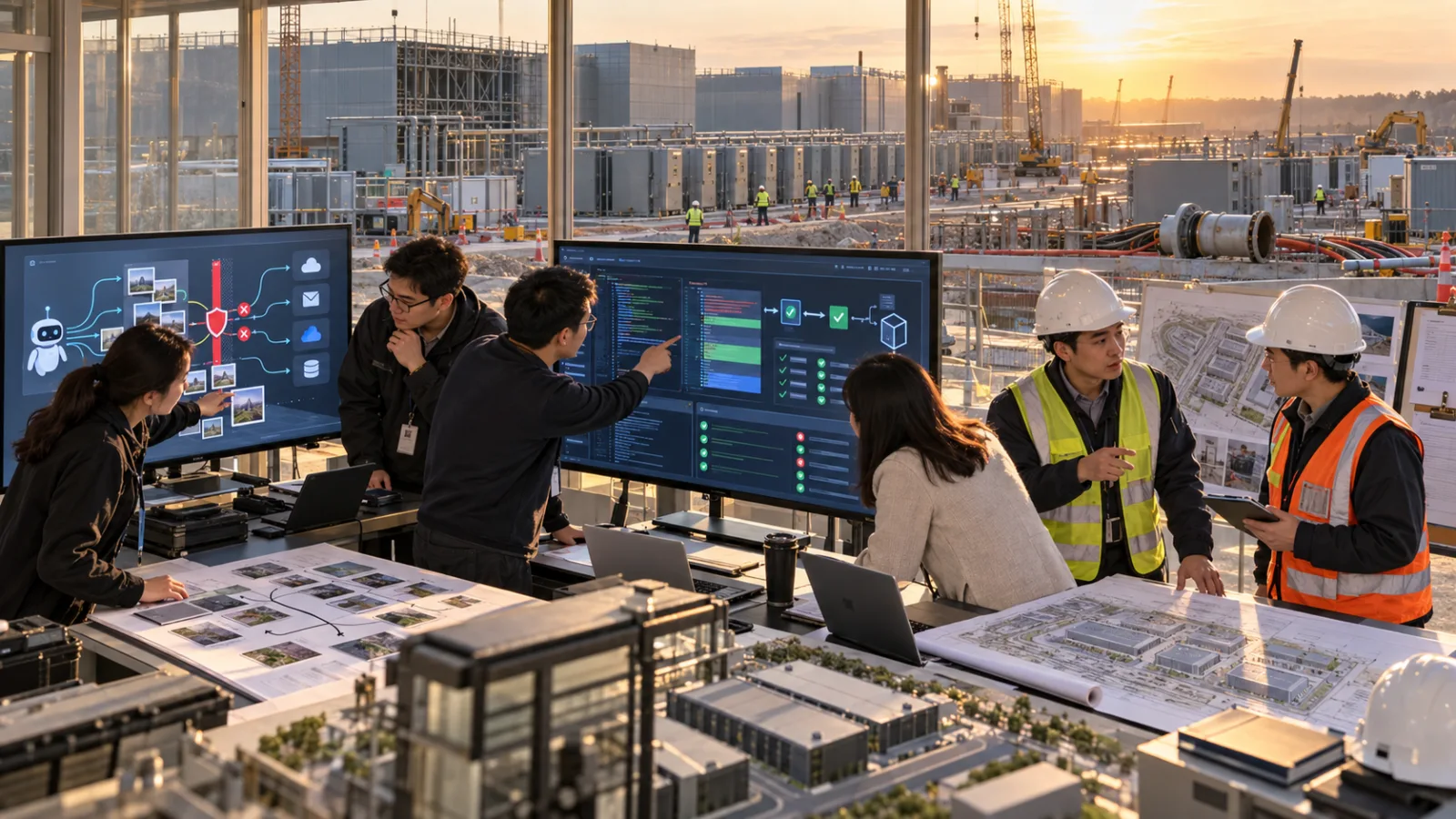
Today’s three AI news items
are not competing on:
whose model benchmark rose by a few points.
One enters:
US air traffic control.
Another directly becomes:
a laptop starting at $899.
The third begins to ask:
How much electricity and water are you really using?
AI is moving from
“able to answer questions”
to
truly participating in foundational systems.
And once systems become critical,
the next questions naturally become:
What can it do? Who decides? And what’s the cost?
① FAA starts using AI to predict flight delays, but it won’t control planes on its own
The US Federal Aviation Administration,
FAA,
as of September 21, has begun limited use of a new airspace management system:
SMART.
Full name:
Strategic Management of Airspace, Routes and Trajectories.
Its mission is not to:
autopilot aircraft.
Instead, it consolidates the vast scattered aviation data,
helping humans detect ahead of time:
where congestion might occur.
It integrates 200 data streams at once
FAA officials say
SMART collects
200 data streams
into a single platform.
These include:
weather,
flight paths,
traffic flow,
air traffic controller staffing,
and other airspace operations information.
Its AI-supported engine combines all this data,
allowing aviation specialists to see:
where planes are headed,
how much traffic a sector can handle,
where weather may cause delays,
and where capacity problems may arise.
The core concept is not:
“wait for a problem, then react.”
But rather:
“predict where potential issues may occur ahead of time.”
Why flights can be delayed before they even take off
Flight delays are not always:
due to mechanical issues.
Sometimes the problem lies in:
overall airspace capacity.
For example, at 5 PM,
a surge of flights may be entering a city.
In normal weather,
this might be manageable.
But if a thunderstorm suddenly shuts down a large airspace sector,
available routes shrink,
and all planes start:
rerouting, queuing, holding patterns,
and delayed departures.
Traditionally, such adjustments happen reactive to problems.
FAA aims for SMART to pull the process earlier.
SMART can forecast hours, days, even weeks ahead
FAA explains SMART goes beyond:
the present moment.
It utilizes:
demand,
weather,
and airspace constraints
to help plan weeks ahead.
For example, if a region’s scheduled flights on a given day are high,
and weather models predict limited airspace,
FAA can proactively evaluate:
rerouting,
adjusting traffic flow,
and capacity management.
This is where predictive analytics add real value in operations.
But AI won’t decide plane routes itself
This is crucial.
FAA explicitly states:
SMART
cannot replace air traffic controllers
nor
take control of aircraft.
All recommendations must be
reviewed by FAA staff,
and local air traffic control supervisors have the authority to
accept or reject
these suggestions.
Currently the design follows:
AI predicts
→ humans assess
→ humans decide.
Not:
AI predicts
→ autonomously changes routes.
Starting with Washington airspace
FAA began limited deployment of SMART on September 21
in the airspace surrounding Washington, D.C.
Plans call for gradual expansion to other regions across the US.
This system follows a
12-year, $875 million contract
FAA signed with Air Space Intelligence in June.
This is not a short trial of AI software,
but a long-term air traffic modernization effort.
Its goal is improved system coordination
FAA aims for reductions in:
delays, cancellations, airborne holding patterns,
and diversions,
while more effectively utilizing airspace and easing controller workload.
Better routing could also help airlines save fuel and reduce overtime, improving aircraft utilization.
But it’s too early to say:
“AI has eliminated US flight delays.”
Today it’s still a limited deployment,
and results must be carefully analyzed as usage grows.
Unlike typical AI, errors here carry high stakes
If a chatbot missummarizes your email,
you can simply redo it.
But air traffic control is a
safety-critical system.
What makes SMART notable is not just
“FAA finally uses AI,”
but
where AI is placed in the system.
Currently it is used for
prediction, aggregation, and recommendation,
not final authority.
This highlights an important AI deployment model:
Use AI to scan vast complex variables humans struggle to track simultaneously, while leaving consequential decisions to people.
② Googlebook opens preorders: Google aims to make Gemini the “core of the computer”
The second news item is closer to everyday users.
On September 21, Google officially launched preorder sales for
Googlebook
starting at
$899.
This is not Google manufacturing a single laptop model.
Initial manufacturing partners include:
Acer, ASUS, Dell, HP, and Lenovo.
What Google aims to create is a
new premium laptop category.
How Googlebook differs from Chromebook
Chromebooks have long been thought of as:
affordable, cloud-first, education-focused devices
for simple web browsing.
Googlebook takes a different path.
It's centered on:
premium hardware,
more powerful processors,
Android integration,
and
Gemini intelligence.
Google describes it as a shift from
operating system
to
intelligence system.
Meaning AI is no longer just a browser window,
but embedded in
mouse, voice, desktop, phone continuity,
and workflows.
Hardware is far beyond entry-level Chromebook specs
Despite the $899 starting price, the hardware positioning is clearly higher-end.
Initial models feature
Intel or Qualcomm processors,
paired with a
Neural Processing Unit (NPU) delivering over 45 TOPS.
Other specs include
up to 2.8K OLED displays,
haptic glass trackpads,
premium chassis materials,
and up to around 14 hours of battery life.
Google is not simply embedding Gemini into Chromebook;
it aims to redefine a higher-end market segment.
Key feature: Magic Pointer
One standout feature is
Magic Pointer.
Users quickly wave the cursor,
invoking Gemini AI next to the content they're viewing.
It understands:
text, images, screen context.
For example, when viewing a marathon training plan,
you can select portions and ask Gemini to add the training dates directly to your calendar.
Spot a suspicious email? Ask Gemini to analyze text and images to assess potential spam.
See multiple images? Ask Gemini to combine them into new visuals.
This shifts AI use from
copy, open chatbot, paste, re-explain context
to
the thing you’re looking at becomes the context itself.
Second feature: Rambler
Googlebook also offers
Rambler.
This is not just basic speech-to-text.
Typical dictation replicates filler words, repeats, self-corrections verbatim.
Rambler organizes your spoken "brain dump"
into structured text such as
meeting notes,
action items,
checklists,
and supports switching languages mid-sentence.
It’s more about
understanding intent first, then organizing
rather than
transcribing word for word.
Third feature: Create widgets via natural language
Another function is
Create My Widget.
Users can describe what they want on the desktop, e.g.,
a travel countdown,
tracking a sports team,
or organizing daily info.
Googlebook then builds a custom widget.
This exemplifies a key AI trend:
software adapting
interfaces to user needs
rather than forcing users to adapt to static software.
Android and laptop finally truly integrated
Another strategic focus is
Android.
While Android dominates phones, many users return to laptops running Windows, Mac, or Chromebook, losing seamless continuity.
Googlebook seeks to change this.
Official features include:
Continue On
– start on phone, continue on laptop.
Files
– view phone files and photos on laptop.
Cast My Apps
– stream phone apps inside laptop windows.
Googlebook’s real competitor is Apple’s
iPhone plus Mac ecosystem,
but Google’s core is:
Android + Gemini + Laptop.
Googlebook includes agent development platform
It also features
Antigravity,
Google’s AI agent development platform.
Developers get full access to a
Linux terminal environment,
running Claude Code, Antigravity CLI,
and other tools.
The environment is isolated via Linux and protected by a hypervisor.
This shows AI laptops’ competition is twofold:
for typical users, AI helps with screen context, voice, and widgets;
for developers, it supports local agentic coding.
Taiwan is not in the initial launch markets
Google announced the first launches on October 4 in the US, with follow-ups on October 5 in Canada, UK, Ireland, France, Germany, and Australia.
Taiwan is not included in this initial group.
Thus, Taiwan users see a global product release, but cannot officially buy Googlebook locally yet.
At $899, Google enters serious PC competition
The pricing is noteworthy.
$899
is no longer
“just a cheap Chromebook.”
Meanwhile, Apple’s expected
MacBook Neo starts at
$699.
This creates an interesting market scenario:
Googlebook starts at $899,
Apple entry Mac starts at $699.
So Google must prove not merely Gemini’s strength,
but whether
Gemini + Android continuity justify a premium laptop price.
This will be the real market test ahead.
③ EU demands data centers disclose resource use
The third story digs to AI’s infrastructure core.
As AI models grow stronger,
the underlying data centers multiply.
The issue shifts from
“Where are the GPUs?”
to
how much electricity and water do these data centers consume?
On September 21, the European Commission proposed a new
Data Centre Rating Scheme.
Its focus is making large data centers’
energy efficiency,
water efficiency,
and grid interaction
>more transparent.
Centers above 500kW included
The scheme covers
individual data centers over 500 kW
capacity.
They won’t just claim to be energy efficient,
but must provide concrete efficiency data with EU-designed ratings and labels,
covering energy and water.
Local water stress factored in
Importantly, the EU doesn’t just ask,
“How much water do you use?”
It also considers whether the data center is located in a
water-stressed region.
Using the same volume of water in a water-rich area
versus a drought-prone zone has very different impacts.
The rules will require data centers to report the relationship between
water use and local water stress.
This shifts AI infrastructure’s environmental cost analysis
from a global average
to the actual location context.
Data centers also evaluated for grid support capabilities
The EU also wants to see if data centers can
contribute positively to energy systems.
Examples include
reusing waste heat,
increasing clean energy generation,
and adjusting loads based on grid needs.
Data centers are massive electricity consumers.
If they always draw full power regardless of grid status,
they increase system stress.
But if workloads can be rescheduled or delayed,
and waste heat recycled for district heating,
data centers could become part of energy solutions rather than burdens.
Recovering half of waste heat would be remarkable
The European Commission gives an example:
If about
half the waste heat
from European data centers were reused,
this could provide heating demands for roughly
4 million homes.
This doesn’t mean instant supply for millions of homes;
district heating infrastructure, distances, temperatures, and investments are needed.
But it illustrates waste heat as a significant reusable energy resource.
Why regulate now?
Because AI is driving rapid growth in European data center capacity.
The Commission hopes in 5 to 7 years,
capacity will roughly triple.
One goal is to build local AI infrastructure,
reducing dependence on US big tech.
But as computing grows, so do
electricity demand,
water demand,
and carbon emissions.
Thus, the EU is balancing a paradox:
demanding more AI compute
while
starting to require transparency about resource consumption.
Data centers currently consume about 2.5% of EU electricity
Reuters cites EU data showing
data centers consume around
2.5% of European electricity.
Capacity is expected to grow from about
12 GW in 2025
to approximately
28 GW by 2030.
IEA estimates quoted by the Commission suggest
data center electricity demand may exceed
3% of total EU electricity consumption by 2030.
While figures vary, the trend is consistent:
demand will continue rising.
This new scheme isn’t an energy cap—yet
It’s important to clarify:
This scheme focuses on
transparency and rating
not
energy caps.
Reuters notes
the scheme won’t mandate maximum yearly electricity use
nor require disclosure of total power consumption.
It demands
efficiency
– how well resources are used.
Minimum efficiency standards may come next
The EU has begun
public consultations
to study potential
minimum performance standards
for energy and water efficiency.
First sustainability labels are expected by 2027.
So today’s actions are more like
measure first, publish, then decide mandatory requirements.
As with many regulations,
without data,
it’s hard to set limits.
These three stories all say the same thing: AI is becoming system infrastructure
FAA’s SMART is
not a
Q&A chatbot,
it deals with
air traffic flow.
Googlebook
isn’t just
one more Gemini app.
It aims to embed Gemini deeply into
cursor, voice, desktop, and phone continuity.
EU data center rules
don’t focus on AI answers,
but on
the physical infrastructure behind AI.
This means AI’s next phase isn’t only about models,
but about
how entire systems operate.
With system integration, three issues arise repeatedly
First:
Who holds ultimate control?
FAA’s answer: SMART predicts, humans decide.
Second:
Can AI truly integrate into existing workflows?
Googlebook aims to prove AI doesn’t have to stay confined in another chat window.
Third:
As scale grows, what are the real costs?
The EU now demands data on energy, water, and grid impact,
not just statements claiming AI’s importance.
So what’s really worth remembering isn’t three new AI updates,
but
AI is evolving from a feature into a foundational daily system.
And once it’s foundational,
the real question is no longer
how smart it is,
but
how reliable it is, who’s accountable, and what resources it consumes.
Today, let’s progress a little with AI.
Learn one AI skill every day.
Save a little time daily.
Enhance your ability bit by bit.
SasaDaily, growing with you.