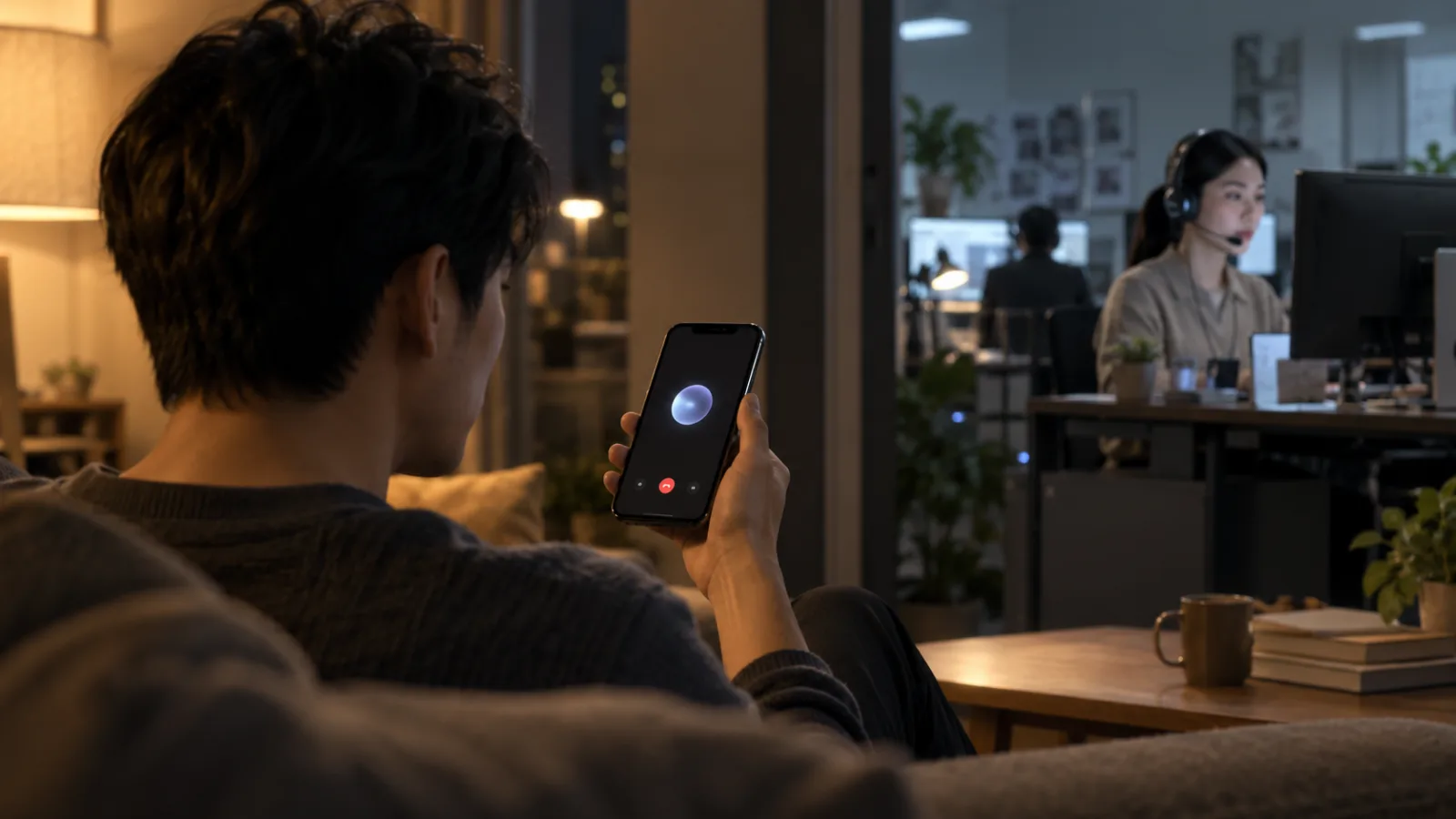
If a stranger you just met online only has a beautiful photo,
you might wonder:
Is this fake?
But what if she has:
Over ten thousand followers.
Nearly 7,000 daily life videos.
New content uploaded every day.
She appears to have a job, a life, and a consistent social footprint.
Would you still doubt her?
This recent case exposed in Shanghai
is notable exactly because of this.
The police investigation revealed that a man thought he was dating a "millennial beautiful doctor."
Only to find out that the young woman persona in the videos was actually a 65-year-old woman.
And supporting this fake identity
were not just one or two edited photos,
but nearly 7,000 videos.
She didn’t look like a temporary fake account
According to Shanghai media relaying police inquiries, a man named Liu Hui (alias) met a woman claiming to be Yu Xiuzhen (alias) through social platforms.
She said she was born in 1992,
and worked as a doctor at a top-tier Shanghai hospital.
Her social account was also very convincing.
Over 10,000 followers.
Nearly 7,000 high-quality life videos accumulated across the internet.
Not just a few selfies,
but a full set of seemingly ongoing life records.
She also told Liu Hui
that she had resources related to hospital property and engineering projects.
Liu Hui himself happened to work in property engineering contracting.
So this relationship initially involved
not only romance,
but also potential business cooperation. Police reports confirmed the authenticity of these accounts, videos, and identity claims.
What’s strange: They lived in the same city, yet never met
But the real problem slowly emerged.
Both claimed to be in Shanghai,
but the other party repeatedly refused to meet in person.
Not even a video call.
The reason was always:
The mother disapproved.
This “mother” not only opposed their relationship,
but even set conditions:
A bride price of 300,000 RMB,
and buying a home in Shanghai.
According to case reports, during about five months of the relationship and financial transactions, Liu Hui transferred a total of 170,000 RMB to the other party. But the promised engineering projects never materialized, and the woman was never seen.
Eventually,
Liu Hui started feeling something was off,
and decided to report to the police.
A detail in the report needs clarification:
Some reports state the two met online as early as 2021 and describe it as a "five-year online romance," but also mention a "five-month relationship" and the 170,000 RMB transfers during that time. So public reports are inconsistent about the timeline.
What is certain is:
The police investigation focused on that crucial five-month period with financial transactions.
Police find: There was no "millennial beautiful doctor"
The police later discovered
Yu Xiuzhen was actually born in 1961,
currently 65 years old.
She had no medical qualifications.
She only worked as a logistics cleaner in a hospital in the past.
In other words,
the entire identity of a “millennial,”
“beautiful doctor,”
from a “top-tier hospital”
was all a fabrication—not what Liu Hui originally thought.
What makes this case truly an AI-era story,
is what the police found next.
Those nearly 7,000 daily life videos weren’t ordinary selfies
The police stated that
the nearly 7,000 videos on the account
were created using AI synthesis, smoothing, and scene compositing to build the young woman persona.
In other words,
in the past,
to create a fake online romance identity,
one might only need:
a few stolen photos,
a fake name,
and a fabricated story.
But such fake accounts had a major weakness:
They had no real life.
Scroll down,
and soon there's nothing.
No yesterday.
No last week.
No continuous everyday life spanning years.
Generative AI began changing this.
It can make a non-existent persona
appear to have abundant "life evidence."
More astounding: The “mother” was herself
The story has another layer.
Liu Hui was repeatedly told:
They couldn’t meet because the mother opposed it.
But police later found out
this “mother” was not another person obstructing the relationship.
Yu Xiuzhen used different accounts to play both:
the girlfriend,
and the "mother."
The police said the “mother” she portrayed had actually passed away long ago.
Meaning,
when Liu Hui thought he was talking to both his “girlfriend and mother-in-law,”
in reality, one operator was maintaining both roles the entire time.
This is especially notable.
Because AI-powered scams are strengthening not just by making faces look more realistic,
but by enabling:
One person to maintain multiple different personas.
The most ironic detail was hidden in the video corners
When police reviewed the videos,
they found a very ironic detail.
Small disclaimers had actually been present in the corner of some videos:
“This content contains AI-generated elements.”
But Liu Hui never noticed.
The police relayed that he had long worked in physical business and wasn’t familiar with AI videos.
This deserves reflection.
We often think,
as long as platforms label AI content,
the problem is solved.
But having a label,
and users actually seeing it,
are two different things.
Especially when you see not just one video,
but dozens,
hundreds,
or nearly 7,000 videos.
Human intuition tends to think:
“If it’s fake, why bother making so many?”
Yet AI excels at reducing the cost of “making so many.”
Thousands of videos may make fakes seem even more real
This is what people should really pay attention to in this case.
Previously, a common way to spot a fake account was:
Check its posting history.
If it was just created,
has only a few posts,
photos vary wildly in style,
and lacks interactions with friends,
then stay alert.
This method still works today.
But it is no longer sufficient as proof of authenticity.
Because AI can reduce the cost of generating content.
A fake identity
can now have:
not just five photos,
but hundreds of photos,
thousands of short videos,
different scenes,
outfits,
and life moments.
The sheer “quantity” of content
is becoming less and less equal to reality.
This isn’t the only case
SasaDaily recently summarized another situation.
Anthropic revealed on a dating app network,
there were over 4,700 AI personas interacting with at least 25,000 users, with the system introducing real videos or real social accounts when users start doubting, to increase credibility.
Dating Apps Claim All Real, But Why Are 3 Out of 4 Matches Actually AI?
These two stories differ in approach.
One is large-scale AI personas run by an app.
The other is an individual using AI to create a fake persona.
But they face the same emerging problem:
The evidence we once used to verify “this is a real person” is now being replicated by AI.
Photos?
Not enough.
Videos?
Still not enough.
Lots of videos?
Still no guarantee.
Even previous video calls
can't always be trusted now as AI face swapping and real-time voice changing improve.
So how to verify?
The most effective way
is not just to learn how to spot every AI flaw.
Because an AI video with imperfect fingers today
might be fixed tomorrow.
Unnatural lip movement today
could be improved by the next model.
Rather than always chasing AI imperfections,
a more reliable method is:
Change how you verify.
Especially when romance,
borrowing money,
investing,
collaborating,
or bride prices and property purchases
are involved,
don’t rely solely on photos or videos the other person provides.
If they claim to be a doctor,
try to verify their identity and employment through independent channels.
If you live in the same city,
and the other party refuses reasonable in-person meetings or live video calls for a long time,
that should raise red flags.
And if they start asking for money transfers,
don’t let the apparently “well-maintained” account lull you into a false sense of security.
Why AI disclosure labels still matter
Another noteworthy part of this case
is that videos already had AI-generated content disclaimers.
This aligns with recent global trends requiring AI-generated content to be disclosed.
SasaDaily previously summarized EU transparency rules for AI-generated images, videos, audio, and chatbots:
Labels aren’t a cure-all.
But without them,
users lose a valuable clue to question authenticity.
Improvement needs to focus not only on
“Is there a label?”
but also on
how obvious the label is,
whether people understand it,
and whether it’s overlooked when content volume is high.
The real scary part isn’t that a 65-year-old looks 29
On the surface,
this story easily becomes:
“A 65-year-old woman used AI to become beautiful.”
But that’s not the main point.
Age isn’t the problem.
Using beauty filters isn’t the problem.
Making AI videos isn’t a crime.
The real issue is:
When AI is used to create a non-existent identity for the purpose of gaining others’ trust and money.
The police also said the woman involved
not only interacted with Liu Hui,
but maintained ambiguous relationships with over ten other people.
The 170,000 RMB obtained from Liu Hui was reportedly spent on cosmetic treatments, skincare, and clothing.
She has been subjected to criminal compulsory measures by public security authorities for suspected fraud.
The case is still under legal process, so she should be referred to as a suspect rather than convicted.
The real question going forward might not be “Is this video real?”
But rather:
“Have I independently verified whether the person in the video really exists?”
AI is making photos cheap,
videos cheap,
voices cheap,
and even an entire person's “daily life” cheap.
When thousands of videos can be fabricated,
our familiar ways of judgment must change.
Seeing a lot of content
no longer equals seeing solid evidence.
Sometimes,
what you are really seeing is:
The same fake identity made many times over.
Understand AI simply and clearly every day.
SasaDaily.com