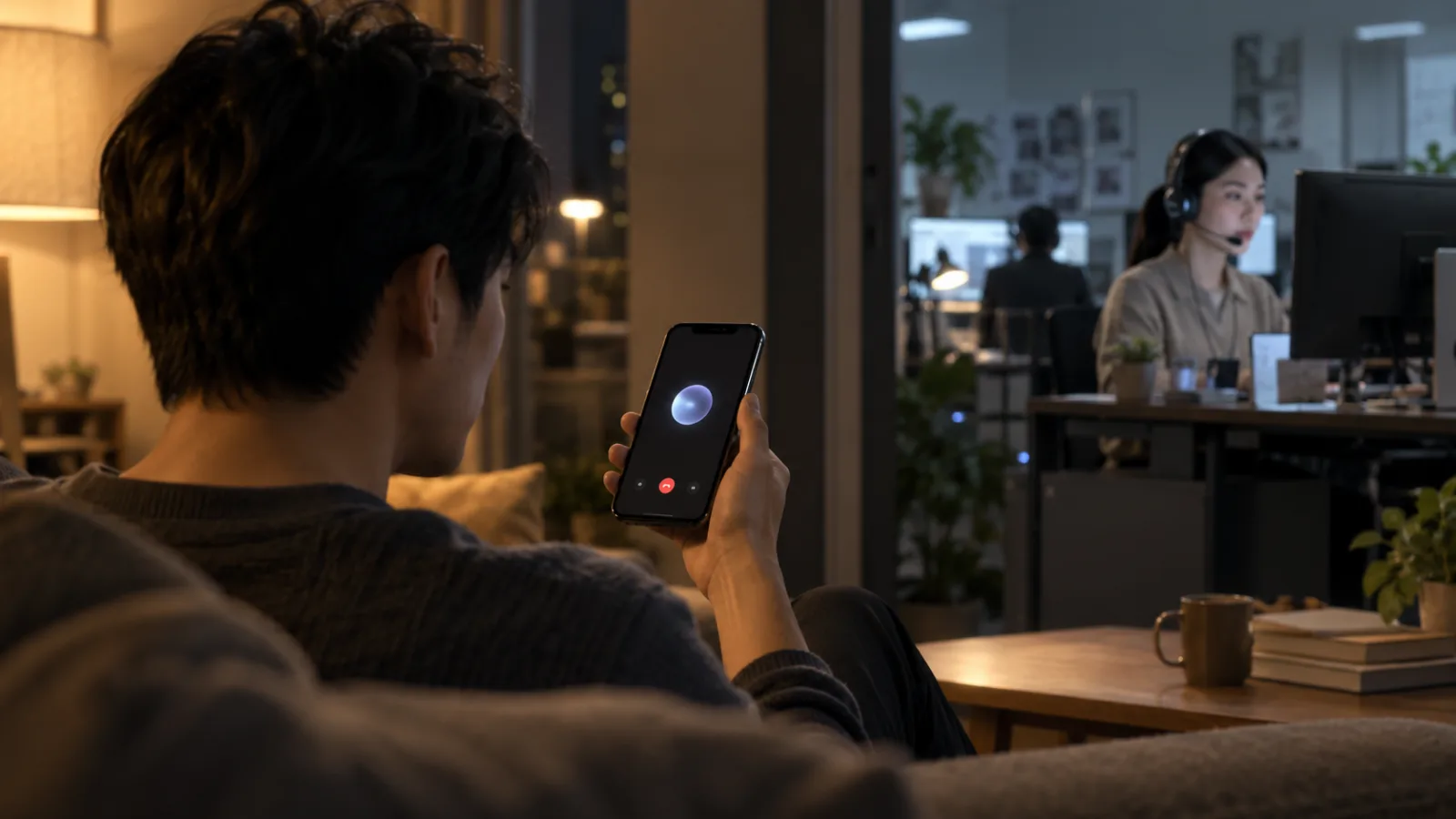
Imagine tonight,
you want to book a table at a restaurant without an online reservation system.
Previously, you’d have to call the restaurant yourself.
Now, you can simply tell an AI:
Call the restaurant and check if there’s availability for Saturday night.
Then all you wait for is the result.
It sounds like this:
The AI dials the number itself.
The AI talks to the restaurant.
The AI brings back the answer.
But Meta is recently testing a different approach.
Some calls initiated by AI might actually be handled by a real person behind the scenes.
Meta Is Testing a "Human Concierge" Feature
On September 22, Reuters obtained Meta’s internal announcement revealing that Meta is testing a feature called human concierge for its personal AI Agent Muse.
The approach is straightforward:
Some calls originally handled by Muse might instead be completed by human contractors.
In other words,
you still assign the task to Muse on the surface,
but in certain situations,
the person who actually picks up the phone and talks to the business
might not be the AI voice,
but a real human.
This is especially interesting,
because the AI industry has been saying for years:
AI can do work for people.
Now we see the opposite picture:
some AI tasks end up being handed back to humans.
Why are humans needed if AI can already make calls?
Muse isn’t just a chat tool.
Meta positioned Muse as a Personal AI Agent that can truly perform tasks when it launched it on September 8.
It uses its own secure virtual computer and browser to handle emails, travel bookings, form filling, shopping, and more. Meta emphasizes users control how much access Muse has.
Recently, Muse started incorporating calling features.
This includes:
Calling restaurants.
Contacting businesses.
Inquiring about services.
Handling tasks that can only be done by phone.
These functions matter because many real-world tasks don’t have APIs.
Lots of small businesses don’t support online bookings.
Clinics may only take calls.
Repair companies may need a human to confirm schedules.
Certain billing issues require talking directly with customer service.
If an AI Agent truly acts on your behalf,
it will inevitably face the world of phone calls. Muse’s calling feature has begun rolling out to some users in the US.
The problem is:
Phone calls are far less predictable than web forms.
The person on the other end might speak quickly.
They might have an accent.
They might suddenly ask unexpected questions.
Or request confirmation of details.
There are also situations where AI isn’t yet good enough.
A human concierge
can fill in those gaps.
The real concern isn’t “humans helping” but whether you know about it
Having humans involved is not inherently problematic.
Many services already work this way:
AI handles initial interactions.
If there’s an issue, a human takes over.
The real question is:
do users know that someone is stepping in?
Reuters reported that some Meta employees have raised privacy concerns internally.
The reason is simple.
When users ask AI to make calls,
they might provide:
names,
phone numbers,
addresses,
reservation times,
service requests,
billing issues,
and even more sensitive background information.
If users assume only the AI system processes this data,
but don’t know some tasks might be passed on to human contractors,
their understanding of “who sees their data”
differs from the actual process.
This is the key point to watch.
It’s not that human customer service is bad.
Rather:
once AI Agents simplify service interfaces too much, the work chain behind the scenes can easily become forgotten.
This is not yet a public feature
It’s important to clarify.
Meta has not announced:
“From now on, all Muse calls will be handled by humans.”
Nor is this feature fully rolled out to all users.
Reuters reported this is an internal employee test.
Meta has granted about half its employees access to test the human concierge feature, and employees can opt out.
Meta spokesperson Daniel Roberts stated the test aims to gather feedback before a public release, improving security and privacy protections.
Meta also said if this feature is ever launched publicly, appropriate disclosure will be made.
So the most accurate way to describe the current situation is:
Meta is testing an AI + human phone service model.
Not:
Muse was secretly just humans pretending to be AI all along.
There’s a big difference between the two.
This challenges a common assumption about AI
We often imagine AI Agents as:
a single model,
a computer,
with humans completely out of the picture,
AI doing everything from start to finish.
But real products are usually not like that.
Practical AI systems often involve:
models,
browsers,
connectors,
APIs,
security systems,
manual review,
customer service,
and real people stepping in when necessary.
So in the future, assessing an AI Agent might require asking:
“Can it do the task?”
And also:
“Who ultimately completed this task?”
This is quite different from past “artificial intelligence” concerns
Many companies in the past were criticized for claiming automated services
when in fact there was extensive human labor behind the scenes.
But Muse's case is different.
Meta hasn’t denied testing human concierges.
Instead, during internal testing, they’re discussing:
how to disclose it,
how to handle privacy,
when it’s appropriate to hand off to humans.
The bigger question is:
should the handover between AI and humans be part of the product interface?
For example:
“This task will be handled by AI.”
“This call may be answered by a human agent.”
“The following info may be shared with contractors.”
If users know this before submitting tasks,
they can decide:
whether they want that,
which information to share,
and what to withhold.
This is completely different from not knowing a human is involved at all.
We’ve already seen another Muse permission issue before
When Muse first launched,
SasaDaily summarized its basic design.
Muse is not just for answering questions,
but can actually perform actions on behalf of users online.
When AI moves from "answering" to "acting,"
permissions become crucial.
For example, when Muse needs to send emails, shop, or perform sensitive actions, it uses an approval process; users should pay attention not just to "approve or not" but also how long the authorization lasts.
Today’s human concierge is just taking this a step further:
Previously the question was:
What can AI see?
Now we have to ask:
What can the humans behind AI see?
Both these prior articles’ titles, URLs, and content direction are drawn from the official site Knowledge Index.
A truly mature AI Agent might never be “all AI”
This might be the most interesting part of the story.
We often interpret the need for humans to step in as:
AI isn’t good enough.
But in real-world commercial services,
the best system isn’t necessarily:
100% AI.
It might be:
80% AI handling tasks quickly,
15% system rule management,
5% humans taking over the trickiest parts.
The key isn’t removing humans completely.
It’s that users must know who they’re interacting with,
who accesses their data,
and who completes their tasks in the end.
The real issue for the future isn’t whether humans are needed,
but:
when humans join the process, and whether users know about it.
If AI helps you gather public data,
this is relatively simple.
But when AI starts to:
make calls for you,
shop on your behalf,
handle bills,
contact hospitals,
communicate with strangers,
then “who’s behind the AI”
becomes part of the product.
So Meta’s human concierge test’s most important takeaway is not:
AI can’t do the job so it quietly gets humans to do it.
But rather:
as AI Agents truly enter the real world, we must know not just which model they use but who ultimately handles our tasks.
Understand AI simply every day.
SasaDaily.com