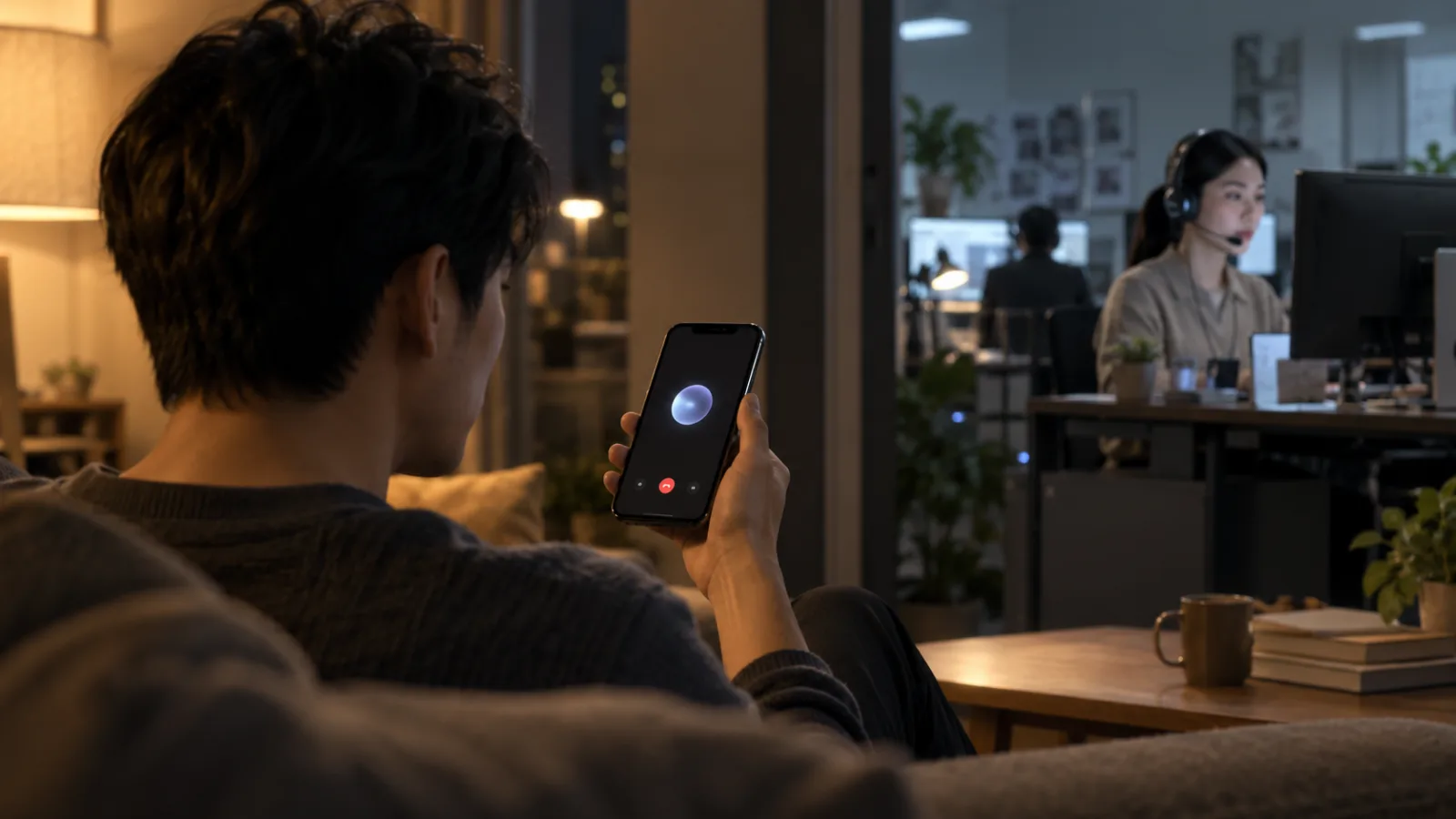
Your phone is already in your pocket.
It already has AI built in.
Your watch has AI.
Earbuds are starting to get AI.
Smart glasses are also getting AI.
Logically,
there shouldn't be any need for another device to carry around.
But Meta recently created one anyway:
An AI you can hang on your keychain.
It’s called the Muse Charm.
It’s Not a Phone or a Smartwatch
Meta first revealed Muse Charm at Connect 2026 on September 23.
It’s a small portable device,
that fits in your pocket,
or can hang directly on your keyring.
The front has a small screen
showing a virtual version of Muse.
A fingerprint sensor sits beside it.
The usage is intentionally straightforward:
touch the sensor once,
and you can start talking to Muse.
No need to take out your phone first.
No unlocking.
No app searching.
No pressing the microphone button again.
During the introduction, Mark Zuckerberg described it as:
if you’re not wearing Meta’s AI glasses now,
this will be one of the fastest ways to access Muse.
What Meta Really Wants to Remove Is “Extra Steps”
At first glance, this device makes people ask:
My phone is right on me, so why would I need this?
But when you break down the process,
Meta’s goal isn’t that phones can’t handle AI.
It’s just that:
You have to take the phone out.
Look at the screen.
Unlock it.
Find the app.
Open the AI function.
Then start talking.
That’s a lot of little steps.
Muse Charm’s mission is to compress those into:
Pick it up → Press once → Talk.
Meta officially positions the Charm as a device made just for “talking and interacting with your Muse,” and says more info will come later.
This looks like saving only a few seconds.
But tech companies care deeply about those few seconds.
If a tool always requires you to:
grab your phone first,
open an app first,
find the right feature first,
many people eventually stop using it regularly.
If it becomes something you carry on your bag or keys,
your usage habits might change completely.
Interestingly, It Doesn’t Look Like a “Work Gadget”
Muse Charm is not a cold, black box.
It has a small screen
that shows an animated character of Muse.
TechCrunch and others have compared it to a Tamagotchi, a digital pet.
This design choice is notable.
Because traditionally, AI assistants have been understood as:
a chat box,
a search box,
a microphone button.
But Meta is trying to make it:
a character that stays with you, that you can call anytime.
The difference isn’t just in looks.
It changes how people relate to AI.
Before, it was:
“I need AI, so I open ChatGPT, Gemini, or Muse.”
In the future, it might become:
“It’s already right here with me.”
How Small Is It?
Meta hasn’t yet fully released final hardware specs.
They’ve only confirmed:
Charm is a pocketable device dedicated to Muse,
with real-time voice features,
and is still being fine-tuned.
External reports based on demos and insider info suggest,
the current prototype is about the size of an AirPods charging case,
with roughly a 2-inch touchscreen,
and it might have 5G connectivity.
It’s important to clarify:
The 2-inch screen, 5G, and other details come from media reports, not Meta’s official, final specs.
Zuckerberg himself said the team is still deciding component layout and final design.
What we see today as Muse Charm is more like:
A publicly displayed, nearly ready prototype.
Not a fully finalized product yet.
Price Is Still Unknown
This is also why there’s uncertainty in details.
Meta has stated they aim to start shipping around the December holiday shopping season.
But so far,
no official price has been announced.
Neither have full details on:
battery life,
final weight,
complete hardware specs,
or initial countries for launch.
If you see anyone listing a complete price or full specs now,
you should verify if it’s official info or media speculation.
The Real Interest Isn’t Just This Hardware but How Muse Is “Popping Up Everywhere”
When Muse launched on September 8,
it was already more than just a chatbot.
It could handle users’ emails, travel planning, shopping, and other tasks,
and even continue running tasks after the app was closed.
SasaDaily previously covered this comprehensively:
Now Meta has announced Muse will be integrated into AI glasses
and into Muse Charm.
In other words,
Meta’s direction is clear:
Muse doesn’t want to live inside just one app.
It wants to follow you across multiple devices.
You’re at your computer,
you can call it.
Wearing glasses,
you can call it.
No glasses,
but you have a Charm on keys or in your pocket you can summon.
Meta even described Connect 2026 as:
building a device family so users can access their personal AI agent from different places.
But “Always-on AI” Also Raises Other Concerns
If AI is just a phone app,
you at least know:
when you open it,
when you’re using it,
and when you close it.
But if AI begins to become:
glasses,
keychains,
earbuds,
or small portable devices,
the boundary between AI and everyday life becomes increasingly blurred.
This doesn’t mean these devices are necessarily problematic.
But users will need to clearly understand:
when the microphone is active,
when the camera might be providing visual info,
what data is being sent to AI,
what tasks AI can perform for me,
and which actions require my explicit approval.
This is why Muse’s true value isn’t just about “answering questions.”
SasaDaily has also examined Muse’s permission system for sensitive tasks like sending emails and shopping:
Recently, another everyday issue surfaced:
when Muse makes calls for you,
Meta is reportedly testing having human contractors take over parts of those calls.
From an app,
to doing tasks,
to making calls on your behalf,
and now to a device you hang on your person,
Muse’s evolution echoes one path in AI development.
The Next AI Race May Not Be “Whose App Is Best”
In the past two years,
AI companies competed on:
whose model is smarter,
who answers faster,
who can handle longer documents,
who can generate better images.
But once all models are good enough,
the next question might be:
who can make AI easiest to reach?
OpenAI can embed ChatGPT in more work tools.
Google can use Android, Gmail, Chrome, and more services.
Apple controls iPhone, Watch, AirPods.
Meta is betting on:
glasses,
social platforms,
and dedicated AI portable devices like the Charm.
At this point, the competition isn’t just “how strong the AI is.”
It’s:
how close AI is to you.
The Real Question Isn’t “Do You Need an AI Keychain”
Whether Muse Charm succeeds is still unknown.
The AI hardware market has seen many failures.
If a new device just relocates a phone app into a smaller box,
users may not want to carry even more stuff.
But what’s worth watching with Muse Charm is not guaranteed success,
it’s that Meta is starting to test a new usage habit:
AI doesn’t need to wait for you to open it.
It can stay with you at all times.
If this direction works,
our understanding of AI may slowly shift from:
“Which AI did I use today?”
to:
“Which AI was with me all day?”
Understand AI daily the simplest way.
SasaDaily.com