You come across a news article.
The website is legitimate.
The layout looks normal.
The article has an author name.
The author even has:
a profile picture,
social media accounts,
and a personal bio.
So, can you at least assume:
“This author is real?”
Nowadays, the answer isn’t that simple.
Short answer: No.
An article published on a genuine media site
only proves that:
this website genuinely published it.
It does not alone prove that:
the author’s identity is real,
the author’s background is true,
or every fact in the article is accurate.
It certainly doesn’t prove:
that no organization is deliberately manipulating information.
An investigation released by OpenAI on October 8
provides a very practical example.
OpenAI Discovered 7 Fake “Journalist” Personas
OpenAI stated that
the company recently shut down an influence operation originating from Iran.
This operation created:
7 Journalist Personas.
That is, seven identities resembling independent journalists.
These identities were more than just
ChatGPT-generated names.
Some also had accounts on:
Medium,
X,
Facebook,
Instagram,
and Threads.
One author even introduced themselves as a:
freelance writer based in the US.
So, when an average reader sees this name, they might find:
articles,
author bios,
social media accounts,
and past posts.
At a glance,
the entire digital identity appears intact.
The Articles Actually Appeared in External Media
OpenAI said that through open-source investigation,
they identified:
nearly 100 articles
published or republished under these false bylines.
The articles span
over ten online media outlets.
The earliest date found was
July 2025,
with articles continuing through
October 2026.
At least some articles were later promoted again through
the media outlets’ own social media accounts.
This is the key point to consider:
It’s not just a case of
“fake sites publishing fake news.”
Rather,
fake author identities can potentially borrow credibility from real media websites.
So How Should You Check Articles on Real Media?
You don’t need to spend hours on OSINT for every article.
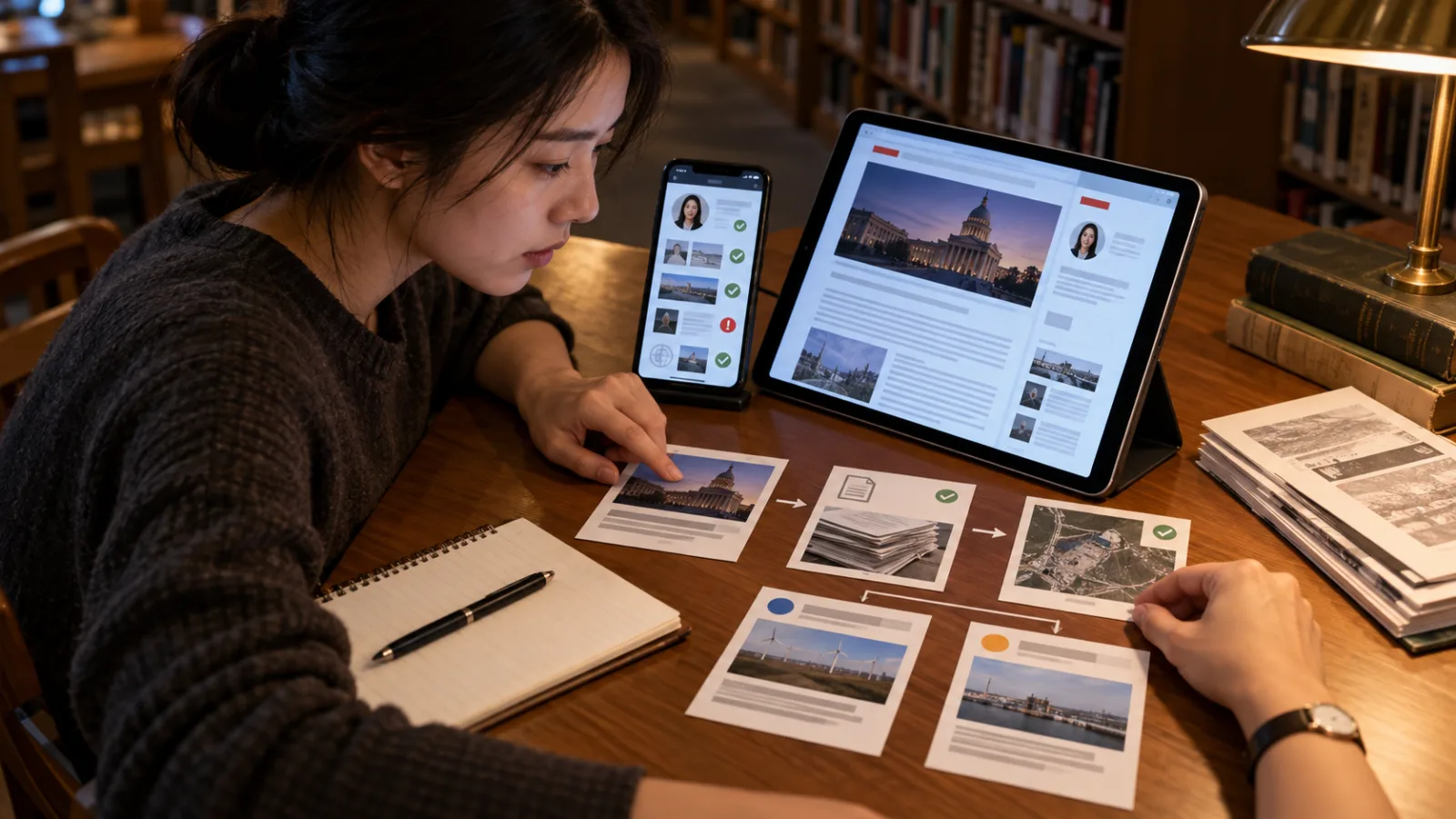
General readers can start with three questions.
1. Who is the Author?
Don’t just rely on the author bio in the article,
because if the identity itself is fabricated,
the bio can be perfectly crafted as well.
Open a new search page and check:
the author’s full name.
Where have they written before?
How long have those articles existed?
Are their profiles consistent across different websites?
Does the author have a long-term, coherent reporting beat?
Is their affiliated organization verifiable?
Are the social media accounts newly created,
or do they show ongoing, consistent activity?
Not Finding the Author Isn’t Proof They’re Fake
This boundary is very important.
New reporters,
freelancers,
and local journalists
may naturally have minimal online footprints.
So:
A lack of information isn’t evidence.
You should focus on:
whether the existing identity details align consistently.
For example, if an author claims
to be reporting from the US long-term,
but public data shows their account is mostly active from a different country,
that’s a red flag worth investigating.
Don’t dismiss someone just because
“they only have 200 followers.”
2. Where Does the Article’s Evidence Come From?
Next, instead of asking,
“Which media outlet published this?”
ask,
“What is this article based on?”
If the article says
a company announced a new policy,
is there a
company announcement?
regulatory filing?
court document?
official study?
public data?
direct interview?
If the article cites
“research shows…”
can you find that study?
If it says
“officials stated…”
can you locate the original statement?
This is called:
going upstream.
Don’t stop at:
Site A says B.
Keep tracing back
where B originally came from.
Links Don’t Guarantee Full Verification
Having sources, citations, or hyperlinks
is obviously better than having none.
But still check:
Do they link to original materials?
Or to another repost or report?
Does the source fully support the article’s conclusion?
Or only part of it?
This is similar to the problem we’ve seen before with AI citations:
Having sources
does not mean:
every conclusion is verified.
3. What Do Other Independent Sources Say?
This step is especially important for
politics,
war,
public health,
major accidents,
financial markets,
and highly controversial events.
Don’t just keep reading within the same site.
Leave it.
Search for:
key people + event,
key company + event,
or original document names.
See if other independent, reliable sources
also report the same core facts.
This is known as:
lateral reading.
Not scrolling down a pretty site
and deciding if it feels real.
But
looking outward to see how others describe it.
Why Is This More Important Now?
Because generative AI has made it much cheaper to
make things look professional.
Previously, building a complete fake identity
would require
a backstory,
articles,
social media posts,
email pitches,
comments,
and maintaining consistent tone.
Now AI can assist with
rewriting articles,
writing pitches,
creating comments,
and sustaining persona tone.
OpenAI’s investigation is an example.
So,
fluent writing,
correct spelling,
and a complete author bio
are becoming less reliable indicators on their own.
But Don’t Automatically Disbelieve Everything AI-Related
The opposite extreme is problematic, too.
OpenAI’s report describes that
the influence operation
used AI models combined with
traditional tactics,
social media,
and other technologies.
It did not prove that
every word in nearly 100 articles
was fully AI-generated.
So, don’t simplify this as:
“AI-written articles are all fake.”
AI might be used to
rewrite,
research,
translate,
organize,
and edit content.
The real judgment still depends on
author identity,
evidence quality,
and verifiable facts,
not guessing,
“this looks like ChatGPT wrote it.”
Small Media Are Not Automatically Untrustworthy
OpenAI pointed out that
the related articles appeared in many
small and medium online outlets.
This does not mean that
smaller media are less trustworthy.
Many important
local news,
industry-specific reporting,
and investigative journalism
come from small editorial teams.
The key things to check are still:
editorial policies,
correction procedures,
transparency of sources,
author verification,
and reporting history.
Don’t automatically equate
“small scale”
with
“fake news.”
If You Only Have 30 Seconds, Which to Check First?
If the content doesn’t matter much,
you don’t need to deeply investigate every article.
But if an article could influence your
sharing,
voting,
investing,
health decisions,
or work,
at a minimum perform these three checks:
Author / Evidence / Other sources
1. Author
Search for the person.
Do their identity and past records align?
2. Evidence
Where does the article’s central claim come from?
Can you trace it back to an original source?
3. Other Sources
Leave the site.
What do other independent credible sources say?
These three steps are far more reliable than
“the site looks professional.”
Editors and Content Teams Should Take One More Step
If you manage a
website,
media outlet,
guest post,
or submission platform,
there’s an additional reminder:
Don’t just review the articles; review the authors.
If a new author suddenly submits pieces on
politics,
international conflicts,
or highly sensitive topics,
take extra measures to verify:
their real identity,
their past works,
contact info,
previous publications,
and citation sources.
You might even require
verifiable data about their identity.
The biggest content risk ahead may not be just
AI generating incorrect citations,
but rather
AI helping package a fully convincing fake persona.
Finally, Remember This Simple Formula
We used to think:
Real website → More trustworthy.
Now it needs to be broken down:
Real website ≠ Real author.
Real author ≠ Every claim is accurate.
Having sources ≠ Conclusion is necessarily valid.
So a more reliable way to judge is:
Who is the author?
Where’s the evidence?
What do others say?
AI can make fake things look increasingly real.
We don’t need to totally distrust everything.
We just need to upgrade
“Looks believable”
to
“I understand why it’s believable.”