You’re just driving to work.
Passing through an intersection.
Going to the supermarket.
Stopping by the gym.
Then driving back home.
You probably don’t even realize,
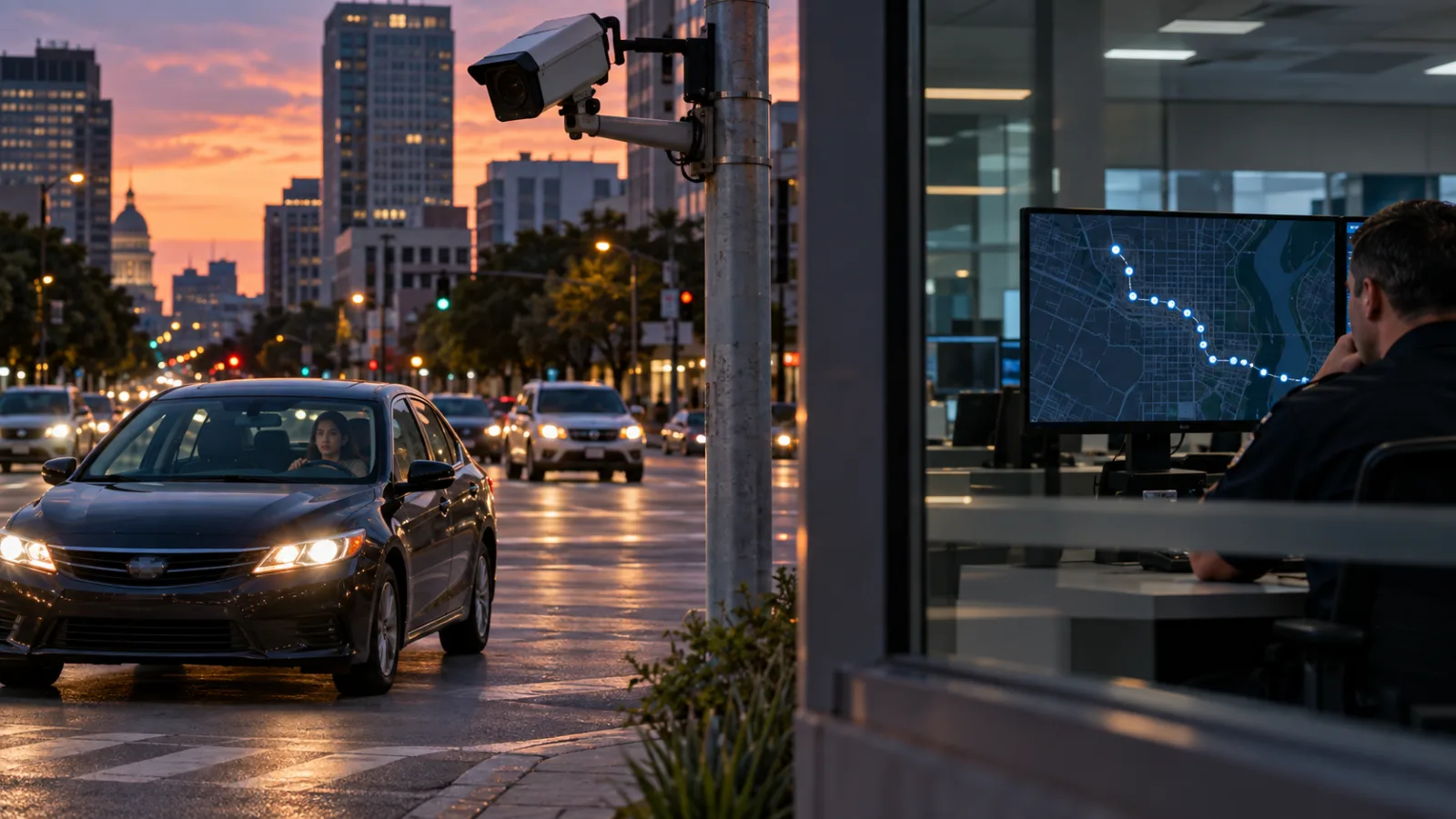
there’s a small camera by the roadside
that’s already recorded:
Your license plate.
Your vehicle.
The time you passed by.
And the location you appeared at.
This system was originally designed to assist police investigations.
But now, in Indianapolis, a very different story has emerged.
Five police officers have been charged with using the department’s license plate recognition system for personal inquiries.
Some are even accused of using the data to track women.
Originally for finding stolen cars, now some officers are accused of using it to track people’s locations
On September 23,
five officers from the Indianapolis Metropolitan Police Department were criminally charged.
The case involves Flock Safety’s automated license plate recognition system, known as ALPR.
Four are currently serving officers, one is a former officer.
Prosecutors accuse them of using a system originally meant for law enforcement purposes to
look up the whereabouts of former partners, spouses, acquaintances, and even women they encountered in public.
These are charges, not court-verified convictions.
But even the querying patterns revealed by prosecutors make the story quite unusual.
An officer is accused not only of tracking but also orchestrating “chance” encounters
Among those charged,
Jonathan Schultz is an 18-year veteran officer.
He faces 26 charges, including fraud, misconduct,
and two stalking-related accusations.
Prosecutors claim he used Flock data to track multiple women’s car locations, including women he met in public.
More importantly,
he allegedly didn’t just look up the data from his computer.
Instead, he used the location info from the searches
to arrange actual “encounters” in real life.
That’s why he is the only one among the accused facing stalking charges.
At this point, the concept of “data privacy” shifts from abstract to very concrete.
Because one location record in a database can reveal exactly:
where you went today,
what time you appeared,
and which direction your vehicle took.
A more striking statistic: over 950 times
Another charged officer was reported by investigators to have
queried his ex-wife’s vehicle location more than 950 times in about six months.
What does 950 mean?
On average, it’s not just occasional checking.
It’s repeatedly knowing the same car’s:
where it appeared,
at what time,
and where it went next.
When this data can be accessed in seconds, the problem shifts from:
“Can the system be used for this?”
to:
“Who is allowed to use it?”
and
“Why are they using it?”
What exactly can Flock see?
Flock Safety’s system doesn’t just take a photo of a license plate.
Official documents show that the license plate reader can record:
the license plate image,
the vehicle image,
license plate number and state,
vehicle color, make, and other features,
date,
time,
and camera location.
Flock also uses machine learning to identify vehicle traits, for example:
sedan or SUV,
color,
whether it has a roof rack,
and even if the full license plate is unknown, it can still find possible matches based on these traits.
Flock now offers FreeForm search,
allowing authorized users to search vehicles and related images via natural language.
They refer to this as AI-powered search.
So yes, it is a vehicle and license plate search system enhanced by AI and machine learning.
But it’s important not to confuse this with what happened in the case.
It’s not the AI suddenly going rogue
This case cannot be described as:
“The AI decided on its own to track women.”
At least based on publicly available information, that’s not true.
The real accusation is:
people with authorized system access actively input searches, retrieve records, and use the results for personal, non-official purposes.
AI and machine learning’s role is to:
make it easier to recognize,
classify,
and search through massive amounts of vehicle images.
The person actually pressing the search button
is still human.
This distinction is crucial.
Because the problem isn’t just about “Is AI safe?”
It’s: when AI and automation make a difficult task take just seconds,
are permissions and controls equally updated?
Tracking a car used to be complicated
Without such systems,
long-term vehicle tracking
usually requires significant manpower.
Someone has to stakeout by the roadside.
Others must review surveillance footage.
And all this footage has to be manually linked across locations.
The cost and effort are very high.
That’s why in the past, only high-priority cases warranted such extensive efforts.
But when road cameras automatically recognize license plates,
and then consolidate:
plate numbers,
timestamps,
locations,
and vehicle attributes
into searchable data,
the cost of querying drops dramatically.
This is very useful for finding criminal vehicles.
Flock officially designates stolen vehicle recovery, missing persons location, and crime investigation as key functions.
However, greater convenience also lowers the barrier for abuse.
Flock does keep search logs
This issue isn’t simply a matter of:
“There is no monitoring.”
Flock clearly states that the system has a per-search audit log.
Every search is recorded.
This case arose after police conducted internal audits and found irregular usage.
Following the incident, Indianapolis police tightened rules:
Now every Flock search must be linked to a specific case or incident number.
In other words,
users cannot just open the system and search,
“Where is this car now?”
They must enter,
“Why do I need this info for this case?”
It seems like just an extra field,
but it’s a vital element of permission systems.
The real issue isn’t what can be done, but what should be allowed
When discussing AI,
we often ask:
What can it do?
How much data can it access?
How fast can it search?
To what extent can it automate actions?
But as tools grow more powerful, another question becomes equally important:
Just because a user can do something doesn’t mean they have the right to do it.
This is similar to what SasaDaily recently discussed about smart glasses.
A pair of glasses might technically record, record audio, and let AI analyze surroundings,
but that doesn’t mean users can freely feed coworkers, whiteboards, and documents into AI inside offices.
Further reading:
Another case touches directly on “technology capabilities versus authorization boundaries”:
These stories seem very different on the surface.
One involves AI agents,
the other road cameras.
But the underlying issue is similar:
As capabilities increase, have boundaries and controls kept pace?
The biggest AI risk isn’t always “going rogue”
When many people talk about AI risks,
the first thought is usually:
Will AI go rogue?
Will it disobey instructions suddenly?
Will it perform actions humans didn’t intend?
Those are important concerns.
But the Flock incident reminds us of another, more everyday risk:
AI doing exactly what it’s told can also cause problems.
Whereas investigating someone’s whereabouts used to take a long time,
now it only takes entering a license plate.
Instead of manually reviewing hundreds of cameras for hours,
the system organizes the data for you.
AI doesn’t invent a human motive.
It just makes difficult tasks faster,
cheaper,
and easier.
But once abuse becomes easier and less costly,
what really needs strengthening
is not just model security,
but also:
who can search,
what can be searched,
why the search is done,
what records are kept,
who audits these actions,
and whether accountability is enforceable.
The most important takeaway is the word “easy”
Flock has many legitimate and important uses.
Police can use it to find stolen cars,
locate missing persons,
and quickly narrow down large vehicle datasets near crime scenes.
So this story isn’t:
“The AI license plate system is bad.”
Nor is it:
“All police abuse surveillance tools.”
The Indianapolis police chief emphasized these charges don’t represent most officers using the system.
The key point is,
technology is changing how hard or easy certain tasks are.
What used to be hard to track
is now easy.
What used to be hard to search across millions of records
is now easy.
What used to be difficult to link sightings of the same vehicle from different places
is now becoming easier and easier.
So in the future, when judging if an AI system is secure,
we shouldn’t only ask:
“What can it do?”
We must also ask:
“When it makes something very easy, who is permitted to press that button?”
Understand AI simply every day.
SasaDaily.com