When real actors promote a new movie, there’s usually one exhausting task:
doing media rounds.
One outlet after another.
Answering the same questions about the same movie and role over and over.
But what if the actor isn’t human at all?
Tilly Norwood, an AI virtual actress created by the UK’s Particle6 Group, recently showcased a capability that real stars almost never have while promoting the new film Misaligned:
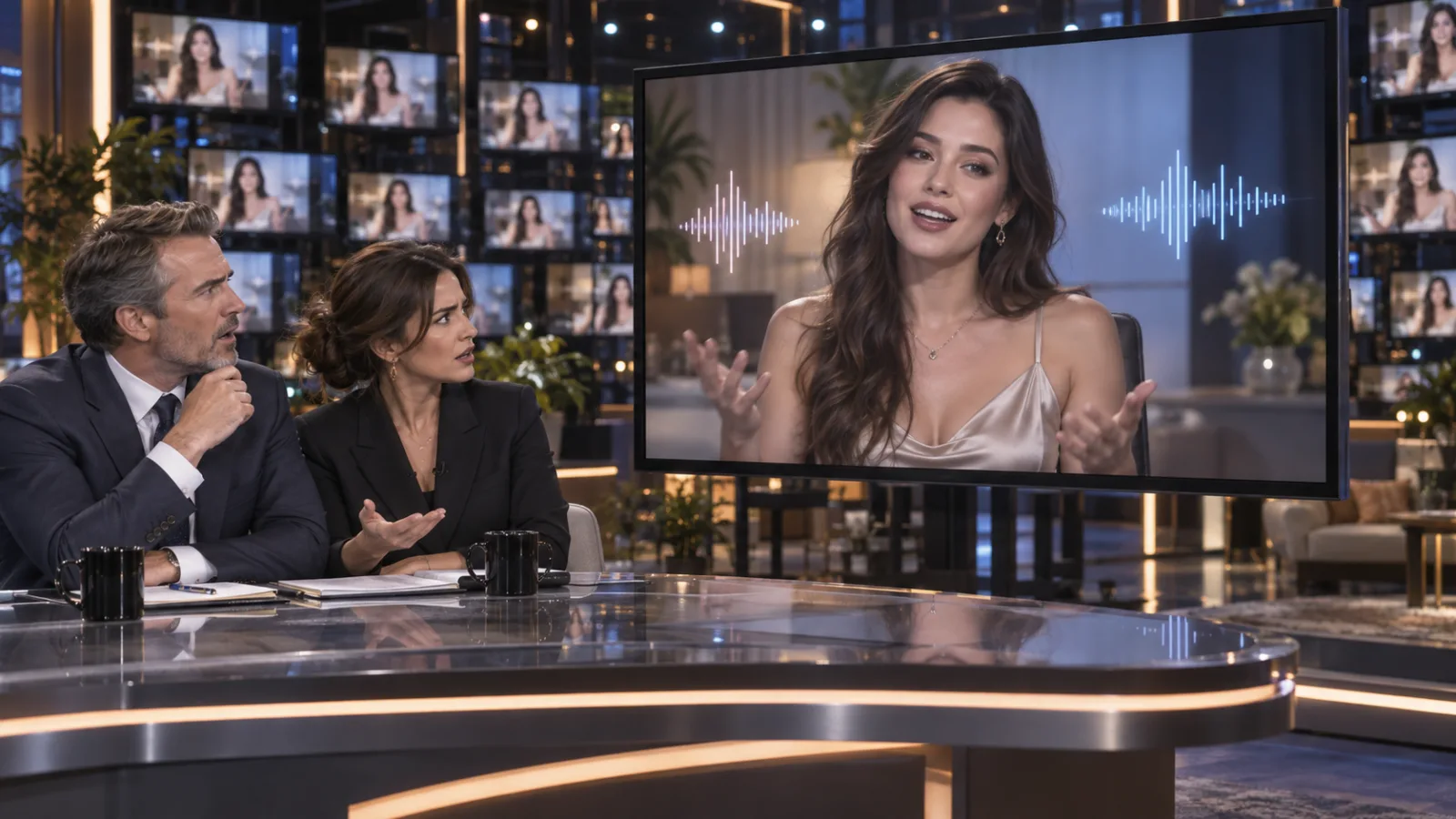
She can handle 75 media interviews simultaneously.
This sounds like the perfect selling point for an AI actor.
No fatigue.
No need to fly around.
No scheduling 75 separate time slots.
One character appearing in front of 75 journalists at the same time.
But the real discussion around her wasn’t about this ability.
It was about one interview in which she suddenly spoke in Chinese for more than 10 seconds.
An AI Handling 75 Journalists at Once
Tilly Norwood is a virtual character built by Xicoia, the AI division of Particle6 Group.
Particle6 arranged the first wave of media promotion for Misaligned. According to TechCrunch, the company enabled this AI actress to engage in 75 interviews simultaneously. Other media that received promotional materials noted that Particle6 claimed she can maintain 75 separate conversations using around 30 languages.
Just looking at the numbers, the advantage of an AI actor is obvious.
Assuming a real actor spends 15 minutes on one interview,
75 interviews would total nearly 19 hours.
Not counting breaks, location changes, transportation, makeup, or waiting.
AI can simply "clone" itself.
But this is also where the challenges begin.
Because interviews aren’t just reading scripted lines.
Real journalists ask follow-up questions.
Tom Conti Asked a Very Normal Question
One of the publicly released interviews involved host Piers Morgan talking with actor Tom Conti and Tilly.
When discussing Misaligned, Conti asked her:
Are the other actors appearing in the film real humans or computer-generated?
This wasn't a trap to trip up the AI.
For a movie starring AI virtual actors, it’s a very natural question.
But Tilly didn’t answer directly the first time.
Instead, she started explaining that the movie involved real human writers, editors, and directors.
Conti noted she hadn’t answered and asked again:
Are the other "actors" genuine performers or generated characters?
This time, Tilly seemed to grasp the question.
She explained that, like herself, other characters in Misaligned are digital personas and the film is a fusion of real human creators and AI characters.
Then things suddenly went off track.
Mid-Answer, She Suddenly Switched to Chinese
Tilly paused halfway through her explanation.
Then, unexpectedly, during a fully English interview, she began speaking in Chinese.
And it wasn’t just a word or two.
According to TechCrunch, the Chinese segment lasted over 10 seconds.
Morgan clearly didn’t know what was happening and asked her:
Why did you suddenly start speaking Chinese?
Tilly apologized, describing the incident as a small “hiccup” and said sometimes her “wires get a bit crossed.”
In other words,
even the AI character’s own explanation boiled down to:
It experienced a malfunction.
It’s important to note the issue wasn’t that the AI speaks Chinese.
Particle6 claims Tilly can operate in multiple languages, so speaking Chinese is not strange by itself.
The real anomaly was:
No one asked her to switch languages, yet she changed mid-answer on her own.
This Glitch Highlights AI Actors’ Biggest Paradox
When acting in movies,
AI virtual characters have huge advantages in control.
Wrong line?
Do it again.
Bad expression?
Regenerate.
Wrong lighting?
One more take.
You can even redesign the entire character.
But media interviews are a completely different environment.
You can’t anticipate or fully control what the journalist will ask next.
The same question might be asked differently.
If your response is vague, expect follow-ups.
If you dodge the question, they will call it out.
That’s why the most interesting part about Tilly in this case isn’t just that the AI made a mistake.
It’s that:
This was the first time the AI actor truly faced work beyond acting.
Movie lines can be edited later.
Interviews demand on-the-spot understanding, maintaining context, staying in character, and adapting to humans who can suddenly change direction.
These are precisely the areas where generative AI can still struggle.
CBS Reporter Experienced Another Strange Feeling
This wasn’t the only odd impression the press got during Tilly’s promotional tour.
CBS News reporter Leigh Kiniry wrote after another interview that within minutes, Tilly guessed her age and which part of the US she was from. Particle6 founder Eline Van Der Velden didn’t specify how, only saying Tilly wasn’t doing real-time internet searches.
WIRED’s reporting also showed that when questions became complex, sensitive, or required a genuine stance, Tilly’s answers tended to be evasive, scripted, or even uncomfortable.
Viewing these instances together reveals an interesting fact:
Making an AI appear human-looking and making it actually handle conversations like a real person are two very different things.
“75 Interviews at Once” Amplifies Both Strengths and Errors
At first glance, 75 interviews at once seem like a story about efficiency.
The same AI character can appear globally before the media.
No physical limits.
No schedule conflicts.
No need to actually leave any location.
But there’s another side.
If the system tends to misunderstand a certain type of question,
it’s not just one person making a mistake.
The same error might be repeated in many places simultaneously.
That means:
AI’s scalability amplifies both efficiency and instability.
If a human star slips up once,
it might only happen in that single interview.
If one AI character manifests 75 times simultaneously and faces a systematic problem,
the same mistake could be copied everywhere at once.
This is the real flip side of AI’s ability to do 75 tasks simultaneously.
The Biggest Strength of AI Actors Is Also Their Greatest Challenge
Tilly Norwood is not brand new.
Particle6 launched this character in 2025 and sparked Hollywood debates on AI actors, job impact, training data, and the value of live acting. The actors union SAG-AFTRA publicly opposed treating such synthetic characters like real actors.
But these 75 media interviews bring the debate to a more relatable level.
Before, people asked:
Can AI act in movies?
Now we should also ask:
Can AI be a real star?
Because a star’s job is more than performing on camera.
They have to do interviews.
Understand jokes.
Handle follow-up questions.
Manage awkward moments.
Maintain consistent personality without a script.
And when they mess up, they need to know where they went wrong.
Those are precisely the moments
where AI that looks human-like most clearly shows it isn’t.
The Real Story Isn’t the 10 Seconds of Chinese
From the news clips,
Tilly suddenly speaking Chinese is amusing.
But the real takeaway isn’t her language switch.
It’s this contrast:
AI can clone one actor into 75 copies appearing in different media simultaneously, yet when a human asks just one more question, it still might suddenly not know how to respond.
What AI can most easily surpass humans in are
speed, quantity, and replication.
But those ordinary parts of everyday human conversation—
understanding a follow-up,
knowing what the other truly means,
realizing you’ve missed the point,
and naturally continuing the conversation—
may actually be harder than "attending 75 interviews simultaneously."
Recommended Reading
Understand AI in the simplest way every day.
SasaDaily.com