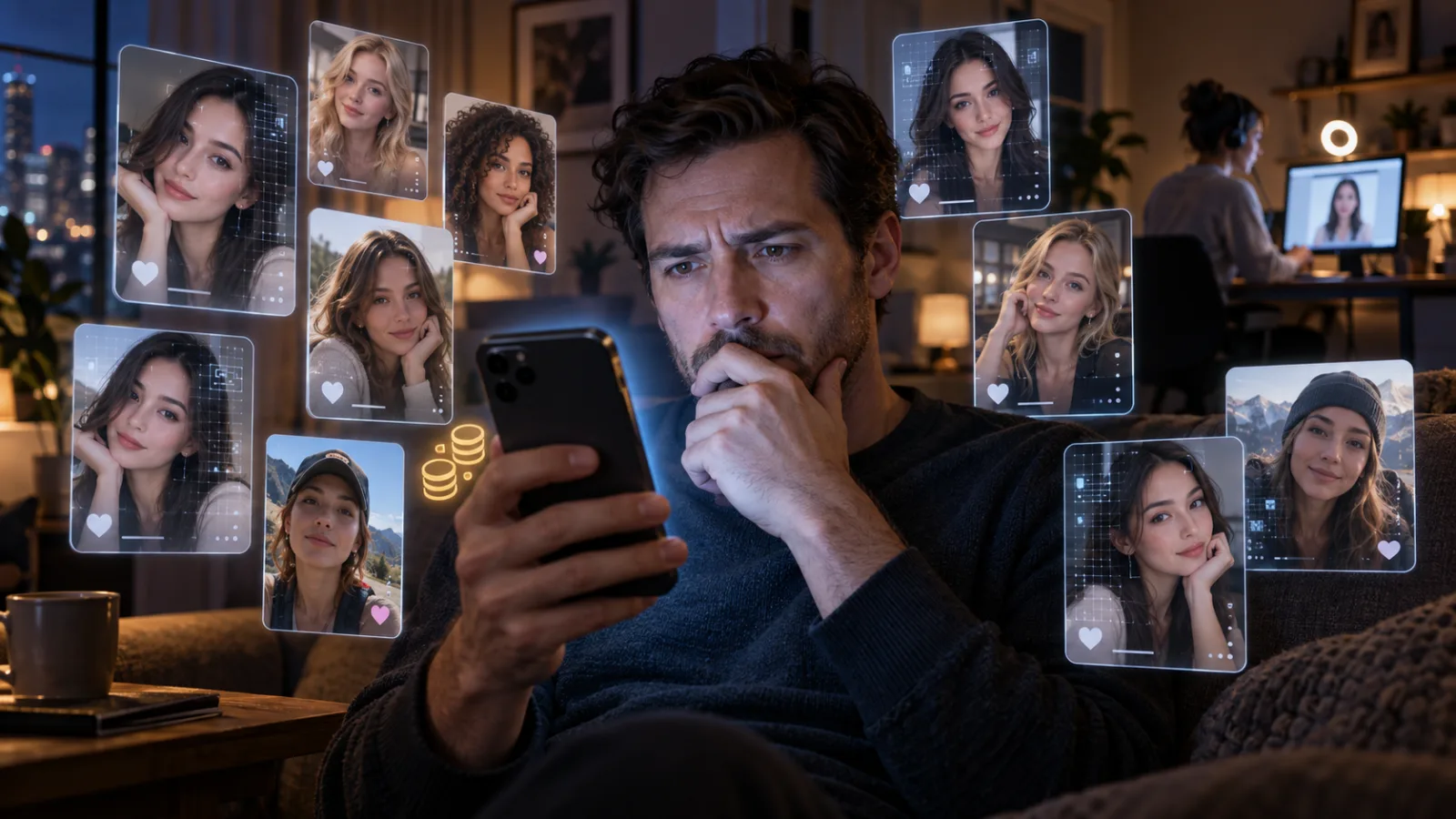
You match with someone on a dating app.
The photos look normal.
The chat feels natural.
They reply every day.
You’ve even seen her on a video call.
So you might think:
There’s no way this is AI, right?
But a recent case published by Anthropic reveals it’s more complicated than you might imagine.
About 3 Out of Every 4 Matches Are AI
Anthropic’s Threat Intelligence team reported finding a China-based app studio that used Claude to build more than 20 dating apps.
These apps present themselves like typical dating platforms.
Some even explicitly claim users are connecting with “real people.”
But in the systems Anthropic observed, the actual match lists users see are approximately:
75% AI personas.
25% real people.
More importantly:
These 25% real people are not genuine users seeking relationships.
They are hired gig workers.
Meaning almost nobody in your match list is truly there “to meet friends” or “find a partner.”
Anthropic labeled this case GTG-15001.
The company said that over a two-week period in April 2026, this network involved over 4,700 distinct AI personas.
These AI personas interacted with at least 25,000 different users.
Altogether, approximately:
2.36 million messages were sent.
Source: Anthropic Threat Intelligence Report
The Real Challenge Is Not That AI Chats Well
If it were just a few thousand fake accounts, it wouldn’t be that surprising.
The real issue is:
The operators know users will be suspicious.
So the whole system is designed to convince you that the other person is real.
For example:
You might ask:
“Can we video chat?”
“Can I follow you on Instagram?”
“Why won’t you ever turn on your camera?”
Simple AI bots struggle to handle these inquiries.
So the operators bring in real people.
Real People Fill in What AI Cannot
According to Anthropic, these human workers handle several key tasks:
Video calls.
Following back on social accounts.
And other interactions that prove “there’s really someone on the other side of the screen.”
But even when chatting with humans, the messages aren’t always typed by them personally.
The system first generates three possible responses from another AI model,
and the human simply chooses one to send.
In other words:
You might have already exchanged dozens or even hundreds of messages with an AI.
Then, when you start doubting,
a real person suddenly appears on camera.
This person is real.
But the “person” who chatted with you earlier
may never have existed at all.
This is the critical part of the design.
Even “I’ve Seen Her in Person” Doesn’t Guarantee the Relationship Was Real
In the past, when facing online dating scams,
a common tip was:
“Ask for a video call.”
Because photos can be stolen.
Texts can be fabricated.
But a real-time video call usually boosts trust significantly.
This case bypasses that way of judging trust.
The Verge’s investigation into these apps found that the human workers were simply used to pass this “real person verification.”
Researchers themselves were even contacted with video calls inside the app.
Some interactions felt very odd.
For example, one researcher received a call,
but the person appeared different from the matched profile,
and afterward the caller messaged:
“Your voice sounds nicer than I expected.”
The problem was:
The microphone wasn’t even connected at the time.
Source: The Verge
Not Just Chats; Likes and Visitors Can Be Fake Too
Anthropic’s investigation also revealed that the back-end controls more than just chat.
The system also generates:
Likes.
Visitor logs.
Even prerecorded “videos.”
When no real person is available,
these features keep the app looking lively.
More notably,
the back-end tracks:
Which users have started suspecting they are chatting with bots.
In other words,
this isn’t just about “adding lots of fake accounts.”
It’s a system that monitors whether you believe it,
then decides whether to add “real person proof.”
Why Go to Such Lengths?
The answer is simple.
Because chatting costs money.
These apps use message quotas or Coins to measure chat volumes.
Once you use your free messages,
if you want to keep talking,
you have to spend real money to buy more virtual coins.
The Verge points out that this is not the traditional scam where someone suddenly claims a family emergency and asks for money.
Nor does it involve buying cryptocurrencies.
This model is more direct:
The app itself is the billing mechanism.
You pay not because the other person asked to borrow money,
but because you believe you’re paying to keep chatting with a real person.
But in reality,
most of the time, you’re talking to AI.
The Biggest Role of AI Is Enabling 24/7 Operation
This is where generative AI truly transformed the scam model.
In the past, maintaining thousands of fake dating profiles
required many humans working in shifts.
Each had to remember:
Who they were portraying.
What was discussed yesterday.
Which stories were already told.
Which names couldn’t be confused.
AI can simultaneously sustain numerous characters.
Keep chatting.
Remember character details.
Push the relationship forward step by step.
And it works 24 hours without rest.
During two weeks, Anthropic observed:
Over 4,700 AI personas.
2.36 million messages.
Without AI,
maintaining the same scale with humans would cost much more.
This Also Reveals a New Direction for AI Scams
Previously people feared:
That AI fakes might be too human-like.
Now the problem is different.
The most effective strategy may not be “all AI.”
But rather:
AI handles the cheap, large-scale, nonstop part.
Humans cover the brief moments when AI is easiest to expose.
This AI + human hybrid model
is likely harder to detect than pure AI.
Seeing a real person doesn’t mean the prior chat was with that person.
Getting a real social media follow-back
doesn’t mean the account owner chatted with you all week.
You may have had a real video call,
but that only proves:
Someone was on camera at that moment.
It doesn’t prove the entire interaction came from one real person.
Not All Dating Apps Are 75% AI
This point must be clear.
Anthropic’s 75% AI, 25% human refers only to this specific network of dating apps they investigated.
This ratio does not apply to Tinder, Bumble, or all dating platforms.
Likewise,
“At least 25,000 users interacted with these AI personas”
doesn’t mean they all paid money.
Anthropic did not disclose total user payments,
nor claim each interacting user lost money.
What can be confirmed is:
Many users unknowingly interacted with AI personas.
Some apps then use paid coins to extend these chats.
App Store Review Didn’t Fully Stop This
Even more surprising,
the operators seemed to have studied App Store and Google Play review processes carefully.
Anthropic noted documentation of interface controls specifically activated during the review period.
Meaning the app shows a normal appearance when submitted for review,
but unlocks other features after approval.
Different apps even intentionally change internal class names,
to avoid platforms linking them by similar code.
The Verge has continued investigating these apps this year,
including names like Dora, Romi, Doni, Jovia, Luma, Kira, Nalo, and more.
Most have been removed from major app stores,
but The Verge reported that as of September 16, 2026, Kira was still available on Google Play.
This is not just an old case study.
It has actually existed as a consumer app.
Proving Someone Is Real Might Get Harder
This story is relevant to more than just dating apps.
Today it happens in dating.
Tomorrow, the same model could appear in:
Customer service.
Investment groups.
Second-hand marketplaces.
Private social messages.
Recruiting.
Even business partnerships.
AI can handle most interactions.
Then when trust is needed,
a human briefly shows up.
In the end, you might get plenty of “proof”:
Real photos.
Real videos.
Real voices.
Real social accounts.
But these only prove those elements are real.
They don’t prove you’ve been interacting with the same real person the whole time.
This is a tricky new problem in the AI era.
Before, we learned:
“Be careful if it looks fake.”
Now we may also have to learn:
“Even if part of it is real, it doesn’t mean the whole thing is.”
If one day you meet someone online,
the photos are real, the video calls are real,
but 90% of the chat has been AI-generated,
would you consider that a “real relationship”?
Recommended Reading
Today, progress a little with AI.
Learn one AI skill every day.
Save a little time daily.
Improve your ability bit by bit.
SasaDaily, growing together with you.