Imagine one day,
you open your ride-hailing app,
and a car really shows up.
The door actually opens.
But there’s no one in the driver’s seat.
The first question many people ask is:
Where did the original driver go?
Lyft is now providing a fascinating answer in Nashville.
Not everyone disappears.
At least some people,
just move to the other side of the car.
Lyft now really can send you a "driverless car"
On September 9, 2026,
Lyft and Waymo officially announced that,
when passengers hail rides through the Lyft app in Nashville,
they might get assigned a fully autonomous Waymo vehicle.
No safety driver.
No human behind the wheel.
Passengers still do the usual:
open Lyft,
choose a trip,
and wait for a car.
But the vehicle picking you up,
might no longer be driven by a Lyft driver,
but by an autonomous driving system.
Lyft hasn’t removed all human drivers.
Nashville still operates a "mixed network".
Cars driven by people,
and cars that drive themselves,
exist side by side.
But driverless cars don’t just magically appear on the road
Here’s where the story becomes truly interesting.
Many see Robotaxis and assume:
Since the car drives itself,
people are no longer needed.
But a driverless car going out every day to serve passengers
actually requires a lot of behind-the-scenes work.
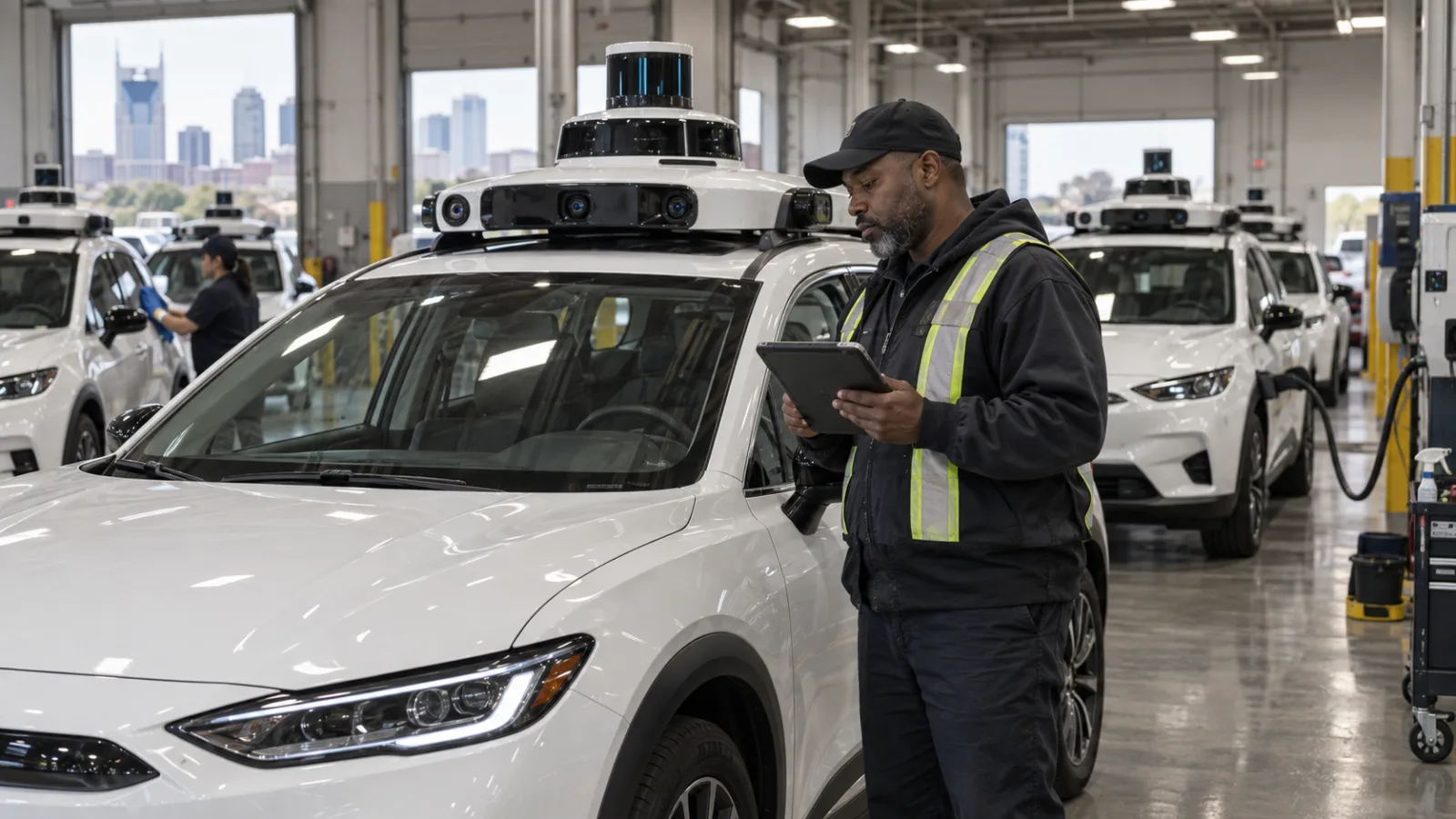
The cars need cleaning,
charging,
inspections,
repairs,
sensor status checks,
scheduling—which car goes out and when,
as well as repositioning vehicles to busier areas.
When something goes wrong,
someone still needs to handle it.
Waymo’s strength
is making cars drive themselves.
But in Nashville,
the team actually responsible for fleet operations
is Lyft’s Flexdrive.
They handle vehicle maintenance, infrastructure, and depot operations.
In other words:
The task of driving is automated.
But running a fleet of self-driving cars day-to-day
creates an entire new set of jobs.
Even more interesting: many doing these jobs used to be Lyft drivers
WIRED visited Lyft’s temporary operations center in Nashville.
There are currently 72 staff members there.
Lyft told WIRED that
about half of them
were formerly Lyft drivers.
This is a notable figure,
because it gives a concrete example of the often-heard claim:
“AI will create new jobs.”
Before,
these workers were behind the wheel,
driving passengers to their destinations.
Now,
some of them have shifted to jobs like:
cleaning driverless cars,
preparing vehicles,
checking vehicle conditions,
managing fleets,
and ensuring the cars can keep servicing passengers.
Jonathan Baines is one example
WIRED interviewed former Lyft driver Jonathan Baines.
He started driving with Lyft in 2016,
having nearly 10 years of experience.
His old job was simple:
drive,
pick up passengers,
and drop them off.
Now,
he’s a Fleet Operations Lead.
He no longer sits inside one car all day.
Instead, he supervises staff
to ensure Waymo vehicles meet cleaning, preparation, and operational standards.
In other words:
before:
one person controlled one car.
Now:
one person manages a fleet of self-driving cars.
This shift
may be the real work transformation brought on by autonomous driving.
It’s similar to how elevators evolved from needing operators to just maintenance staff
Early elevators
often required an operator.
After getting in,
someone would control the elevator’s movement, stopping, and doors.
As control systems became more automated,
that job gradually disappeared.
But elevators didn’t evolve into:
“completely needing no human.”
People’s roles just changed.
Now no one stands inside the elevator to press buttons,
but people are still needed for:
maintenance,
inspections,
repairs,
monitoring,
and handling malfunctions.
Robotaxis are likely heading the same way.
What truly disappears
may not be “all jobs related to driving,”
but specifically:
the daily act of a human sitting in the driver’s seat controlling the steering wheel.
But we shouldn’t be overly optimistic
Seeing former Lyft drivers shift to Waymo management in Nashville,
we can’t conclude that
all drivers displaced by Robotaxis
will easily transition to autonomous vehicle jobs.
These numbers are not the same thing.
A city might need thousands of drivers,
but how many people are needed to maintain an entire Robotaxi fleet—cleaning, repairs, fleet operations?
There’s no answer yet.
Also, the skill sets for new jobs
may not match previous driving jobs.
Being able to drive
doesn’t automatically mean knowing how to:
maintain sensors,
manage charging stations,
operate fleet systems,
analyze equipment issues,
or fix technical problems.
So “job transformation” doesn’t mean:
each old job has a one-to-one replacement new job.
This is why Lyft emphasizes a "mixed network" approach
Lyft’s current stance is clear:
human drivers and self-driving cars
will coexist on the same platform for a long time.
In Nashville,
passengers can opt out of Waymo self-driving rides.
Human drivers continue providing rides.
So it’s not the case that:
“the moment Robotaxis arrive, all Lyft drivers disappear.”
It’s more of a transitional period.
In the same city,
some cars are driven by humans,
while others drive themselves.
Some workers drive passengers,
while others start caring for the autonomous vehicles behind the scenes.
The real change is work shifting from "operation" to "management"
This isn’t unique to ride-hailing platforms.
Yesterday we saw JD Logistics’ warehouse robots,
which point in the same direction.
When machines start moving goods by themselves,
people’s work gradually shifts from:
doing the moving themselves,
to managing the moving robots.
When cars start driving themselves,
people’s work may gradually shift from:
driving,
to managing autonomous fleets.
When AI agents start handling workflows,
people’s roles may shift from:
operating every step,
to setting rules,
monitoring results,
and managing exceptions.
These changes share a common pattern:
humans move from being system “operators” to system “managers.”
But managers tend to be fewer than operators
This is the side we cannot ignore.
If you previously needed 100 people behind the wheel for 100 cars,
in the future, 100 Robotaxis
might require fewer people for:
cleaning,
charging,
maintenance,
scheduling, and
management.
This is why:
“AI will create new jobs”
and
“AI will not reduce jobs”
are two very different things.
New jobs may appear.
But how many?
What skills do they need?
How much do they pay?
Can existing workers transition?
These questions deserve separate consideration.
Lyft is conducting a large-scale experiment
Lyft’s temporary Nashville operations center
is only the beginning.
The company plans to launch a dedicated 80,000-square-foot AV Depot in October.
If the number of Waymo vehicles grows,
that facility will give us real insight into:
how many people are needed to maintain a large robotaxi fleet,
which roles grow,
which roles shrink,
and how many cars one employee can manage.
These figures may be even more important than whether Robotaxis succeed commercially,
because they show us
where human roles will end up once automation becomes routine.
The most important thing to watch isn’t just Waymo’s expansion to another city
Waymo entering Nashville
is certainly a major autonomous driving headline.
But what truly deserves attention
is the group of former Lyft drivers at the Lyft Depot.
They provide the clearest view yet of:
what new jobs look like after automation takes over existing tasks.
Not everyone will transition successfully.
Not every old job will be replaced one-to-one by a new job.
But many future job changes
won’t be about sudden disappearance,
but about gradually shifting core activities from machines to humans.
From driving ourselves,
to caring for vehicles that drive themselves.
The next question is:
As AI starts doing more tasks for us, will we also have to learn how to manage the AI and machines that work on our behalf?
Today, let’s progress a little with AI.
Learn one AI skill a day.
Save a bit of time each day.
Improve your abilities step by step.
SasaDaily, growing with you.
Recommended Reading
Why is Uber encouraging drivers to limit Waymo even while pushing Robotaxis?
Why are Chinese courts ruling that AI can’t be used to lay off employees just because it’s cheaper?