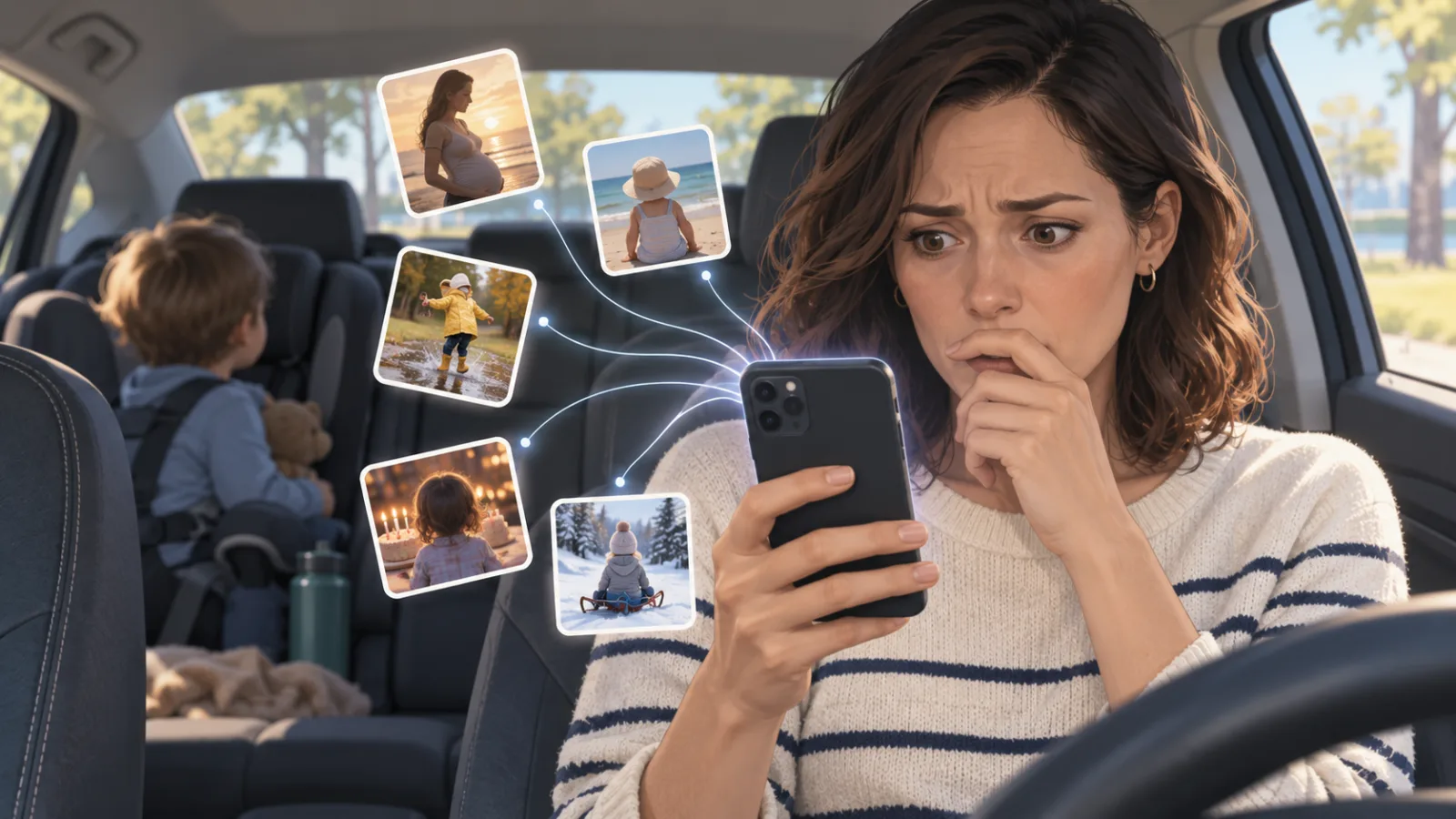
She initially just wanted to share a simple family video.
Kalie Robins, a mother in the U.S., was singing with her daughter in the car.
She shared the video on Instagram and also posted it simultaneously on Facebook.
This kind of content appears countless times on social media every day.
But later, under the video, she saw a suggested question provided by Meta AI:
"Who is the child in the car?"
After clicking it, things started to get uncomfortable.
AI Didn’t Just Look at This One Video
According to Robins, after clicking the question, Meta AI began piecing together content she and her friends and family had posted over the years.
Photos and family information originally scattered across different years and accounts started to be organized into a more complete background.
This included photos related to her child, the child’s name, and other family-related clues.
The system even produced more suggested questions concerning the child’s age and the family’s location.
The Verge reported that Robins also stated the system once showed a photo she believed she had deleted years ago.
But it’s important to clarify:
This is Robins’ own account.
Meta has not confirmed that the system actually "restored a photo that was fully deleted from the platform."
So this incident shouldn’t be directly interpreted as:
Meta AI can retrieve photos you have deleted.
There is not enough evidence to support this conclusion at present.
Source: The Verge
The Real Discomfort Might Not Be AI Stealing New Data
But rather:
AI is exceptionally good at piecing together old data.
Imagine this.
You might have never written all this information in a single post:
This is my daughter.
Her age.
Her name.
Where we live.
Who the grandmother is.
Where the family often goes.
But over ten years, this information may be scattered all over the place.
A bit in your own posts.
A bit on grandmother’s Facebook.
A bit in relatives’ birthday wishes.
A bit in old family photos.
A bit in travel check-ins from years ago.
Previously, someone who wanted to collect all this information would have had to spend a lot of time going through each post one by one.
And what AI does best is just that:
Searching.
Organizing.
Cross-referencing.
Finding connections.
Then assembling many fragments into one answer.
That is the truly noteworthy aspect of this story.
She Thought She Had Been Careful
Robins later said she had deliberately avoided sharing many obvious private details publicly.
For example, not including the child’s school name in photos.
Not intentionally capturing nearby street signs around their home.
Not writing the child’s full name in every post.
But this incident made her realize one problem:
Family information doesn’t necessarily come only from your own account.
Some content may have been shared by the grandmother.
Some might be tagged by relatives.
Some may be old posts left behind many years ago.
You being careful doesn’t mean the entire family’s digital footprint over the past decade is equally clean.
Source: Business Insider
Meta Later Admitted This Type of Prompt Should Not Have Appeared
In response to this incident, Meta said the feature "missed the mark".
The company also stated that prompts involving sensitive personal information should not have been proactively displayed, and the issue causing their appearance has now been fixed.
Meta emphasized:
AI should theoretically only return content the requester already has permission to see.
In other words, this incident cannot be directly interpreted as:
Any stranger can use Meta AI to find out all your private family information.
There is currently no evidence in public data to prove this.
The real question to consider is a more realistic one.
Our Past Understanding of "Public Information" May No Longer Be Enough
In the past, a single photo was just a photo.
A baby picture shared ten years ago.
A birthday photo posted five years ago.
A family trip tagged by a relative last year.
Each on its own, none revealed too much.
But AI does not necessarily treat them as unrelated.
It can combine:
People.
Posting dates.
Family relationships.
Text descriptions.
Location clues.
Related content from other accounts.
And understand them together.
The result is no longer just ten separate posts.
But possibly a more complete personal profile.
This is like having a hundred puzzle pieces scattered on a table.
In the past, each passerby saw only a few pieces.
With AI’s arrival, suddenly there’s a tool that can quickly piece many of them together.
"I Didn’t Share This Publicly" and "It Can’t Be Inferred Online" Are Two Different Things Now
Many people’s privacy habits are:
I haven’t shared my address publicly, so no one knows where I live.
I haven’t shared my child’s name publicly, so no one knows who my child is.
I haven’t written family relationships, so outsiders don’t know who is related to whom.
But in the AI era, we need to ask one more question:
Can this answer be inferred from the small clues I and people around me have left over many years?
That is the biggest difference from before.
It’s not that each individual piece of information suddenly became more dangerous.
But the cost of assembling the information has suddenly become very low.
This Is Also Changing How Some Parents Share Photos of Their Children
After this incident became public, some parents have started reconsidering whether to continue posting photos of their children openly on social media.
This isn’t just because of Meta AI.
There are now also issues with AI models, facial recognition, deepfake, and image reuse.
So the question has shifted from:
"Does this photo look risky?"
To:
"If AI looks at this photo alongside all the data I’ve shared over the past ten years, what can it infer?"
This May Be the New Privacy Issue in the AI Era
The biggest change AI brings isn’t that it suddenly knows new secrets that didn’t exist before.
But:
Many pieces of information that already existed, but were too scattered, too old, or too hard to organize, suddenly become easy to compile.
In the past, sharing a photo publicly might have really just been sharing a photo.
Now, sharing a photo publicly may simultaneously add a puzzle piece AI can use to piece together a larger picture.
This doesn’t mean from today onwards people should stop sharing everything.
But our way of thinking about privacy might truly need to change.
From now on, don’t just ask:
"Does this post reveal too much?"
Also ask:
"What would all my publicly available information combined look like?"
If it were you, after reading this, would you reduce posting photos of your children or family publicly?
Recommended Reading
Your Resume May Be Scored by AI Before a Human Even Looks at It — Why Is That Happening?
Today, progress a little more with AI.
Learn one AI skill every day.
Save a bit of time every day.
Improve a little bit every day.
SasaDaily, growing alongside you.