Imagine if your factory suddenly told you:
“Starting tomorrow, this robot won’t install Part A anymore.”
“Switch to a different part instead.”
“And change the order, too.”
For a human,
this might just mean a supervisor stands next to you and demonstrates once.
After watching and understanding,
you give it a try.
But for many robots,
it’s not that simple.
The biggest challenge for robots isn’t moving
Modern robotic arms
can already easily:
grip objects,
place them,
transport,
stack,
and assemble.
The problem is:
when the task changes, they often need to relearn everything.
Skild AI pointed out when introducing the S1 robot,
traditional robots require hours of teleoperation demonstration data
and task-specific fine-tuning for new assignments.
The more complex the new long-step task,
the more demonstrations are needed for reliability.
This might be manageable in labs,
but real factories don’t stay the same forever.
Factories often face frequent changes
Suppliers change parts.
Workstations get rearranged.
Products receive upgrades.
Assembly sequences change.
Packing methods differ.
Whenever the process shifts,
the finely tuned robot
might need retraining.
Skild shared honest deployment experience:
If each change demands new data collection and post-training,
then after a single day of operation,
robots need constant retraining.
This makes scaling extremely difficult.
So Skild’s real challenge isn’t
“how to make robotic arms more dexterous.”
It’s
how to let them learn new tasks faster.
Skild’s solution: Don’t retrain—just show the robot once
The newest robot foundation model from Skild is called:
S1.
What makes it different
is that it applies a familiar AI concept:
In-context learning
to robotics.
When we use ChatGPT,
if we want it to produce something in a certain format,
we don’t have to retrain the model.
We simply give it an example,
and say,
“Do it like this.”
S1 brings the same idea
into the physical world.
But instead of a text prompt,
it receives a:
video.
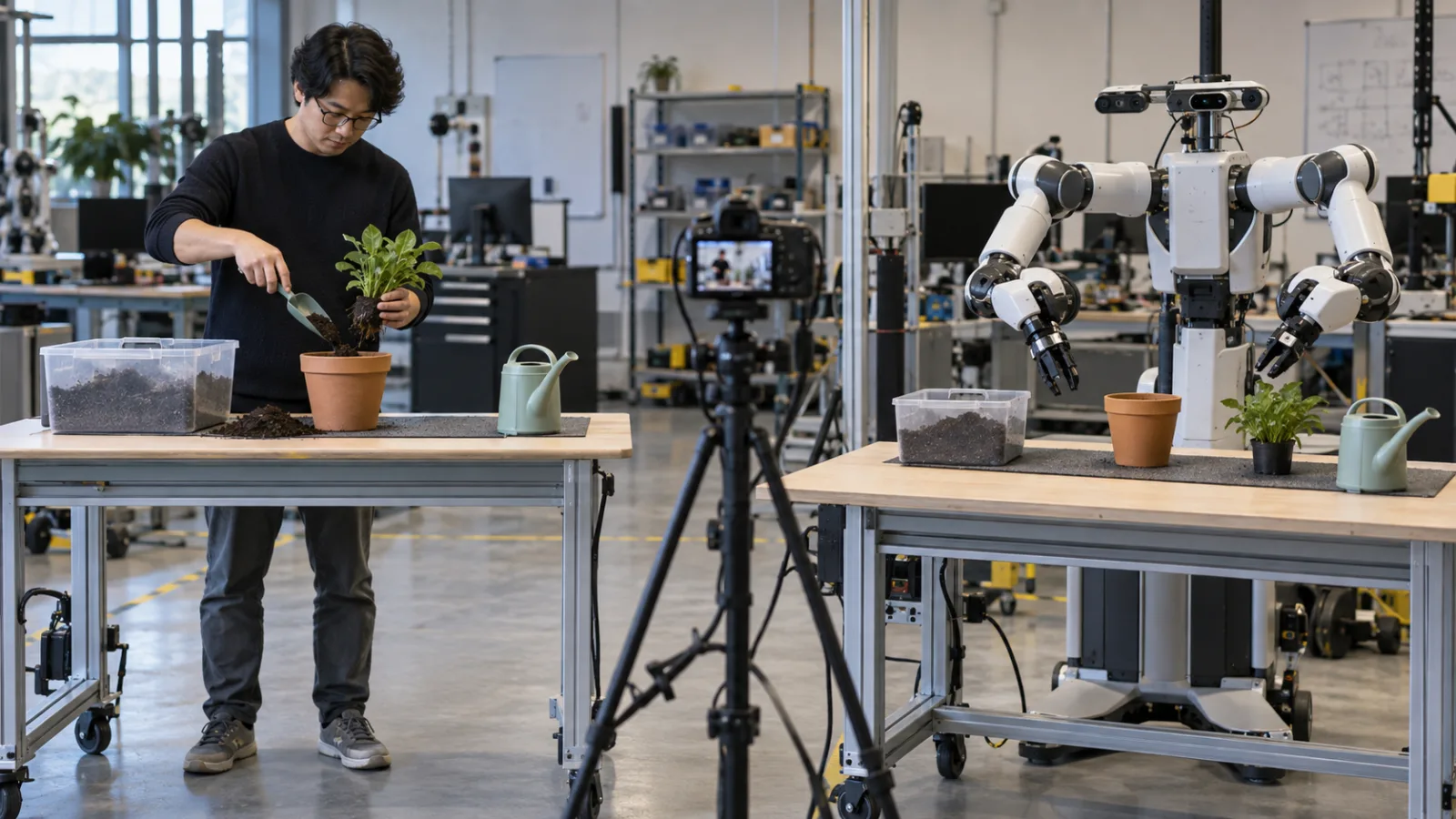
For example: teaching it to pot a plant
You prepare:
a pot,
some soil,
a plant,
and a watering can.
Then you perform the task once.
Put soil in,
dig a place,
place the plant,
cover with soil,
and finally water it.
A camera records the entire process.
Previously,
that video might serve only as
training data,
followed by data processing,
model training,
testing,
and adjustments.
But S1 works differently.
The demonstration video itself is the prompt.
It goes straight into the model’s context.
The model’s original weights aren’t changed,
and no fine-tuning happens for this new task.
So is it just copying the video?
No, and this is crucial.
If it just replayed the exact motions from the video, like:
“Move left 10 cm,”
“go down 5 cm,”
then it wouldn’t be very useful.
The real world isn’t always exactly the same.
The pot might be in a different spot,
the cup moved to another side,
or the tools might differ.
What S1 actually does is:
understand from the video:
what goal the human aims to achieve,
the function of each object,
the relationship between steps,
what step it is on, and
what to do next.
It then translates this understanding
into actions the specific robot in front of it can perform.
Skild explained that the same S1 model weights
can handle tasks both seen and unseen before
without fine-tuning per new job.
The most impressive number: 11 minutes
Skild ran a potted plant test.
At 9:16 PM,
they started preparing to record.
By 9:22 PM,
they finished recording a demonstration video.
At 9:27 PM,
S1 had already started executing the task on real robot hardware.
In other words:
only about 11 minutes passed from recording to autonomous robot action.
This is the key takeaway.
Not:
“The robot finally learned to pot a plant.”
Potting itself isn’t the main point.
What matters is:
the time required to teach a new task could shrink dramatically.
And it’s not just simple small moves lasting seconds
Many robot demos look impressive:
pick up a cup,
place a single part,
open a drawer.
These videos often last just a few seconds.
The real challenge is:
linking many steps together.
The longer the process,
the higher chance of mistakes.
If the first item isn’t placed correctly,
everything afterward could fail.
Skild’s S1 showcased tasks up to about 10 minutes long,
including:
potting plants,
cooking pancakes,
pouring hand-brewed coffee,
and assembling kits.
These jobs involve dozens of operational steps
and were never seen during the model’s pre-training.
Flipping a pancake is a good example
If I said to you:
“Flip the pancake.”
A human roughly knows what that means,
but for a robot,
the instruction doesn’t specify:
where to insert the spatula,
at what angle,
how to rotate the wrist,
how much force to apply,
or how to catch the pancake when it’s flipped midair.
Some physical movements
are really hard to convey well in words alone.
This is why Skild believes for complex physical tasks,
“Showing” the robot how to do something
can be more effective than just “telling” it with language.
But it’s not guaranteed that one viewing means perfect mastery
This point must be clear.
Skild tested S1 on unfamiliar multi-step tasks.
With pre-training data scale reaching 100,000 hours,
the model using video demonstrations for in-context learning
achieved an average cumulative per-step success rate of about
66%.
The comparable language-prompted VLA policy performed around
9%
while 66% is far higher than 9%,
it’s still far from 100%.
In other words,
today’s S1 cannot be seen as:
“Just film once with your phone, and engineers won’t be needed in the factory tomorrow.”
There are still many challenges before large-scale, long-duration, highly reliable production.
Skild even allows manual recovery in evaluations
During tests on unfamiliar long processes,
to run through the entire task and evaluate step performance,
human intervention was allowed to recover the process on failure,
then continue testing.
This means the 66%
isn’t “66% of entire tasks completed without any supervision.”
It’s an average cumulative per-step success rate.
These two should not be confused.
So why is this important?
The real comparison isn’t
66% versus a perfect 100%,
but rather:
how much the cost of teaching a new task can be reduced.
Skild ran another test.
Using the traditional post-training approach,
the baseline model needed about
380 post-training demonstrations
to achieve a similar 66% performance as S1 with a single video.
Each of these 4-10 minute long demonstrations required approximately
50–100 hours of teleoperation data collection.
S1 used just
one video demonstration.
The difference is clear.
Robots are entering their own “prompt era”
One of the biggest shifts brought by generative AI
is that ordinary people don’t need to retrain a model.
They just tell it:
what they want,
give some context,
provide examples,
and it starts working.
Physical AI is now trying to follow the same path.
In the future, factory supervisors and technicians
might no longer have to create new robot training projects every time
a process changes.
Some tasks might only require:
doing the new process once,
recording it,
handing it over to the robot,
and letting it try.
Then humans just check for errors.
This could truly accelerate robot adoption in factories
Factories have never lacked machines that can repeat fixed tasks.
Traditional robotic arms
already excel at fixed, routine jobs.
The real challenge is:
when anything changes, they can’t cope.
Parts move,
tasks fail,
processes change,
requiring reprogramming,
new products arrive,
requiring retraining.
If robots can truly adapt quickly from one demonstration,
then what changes is not just the robotic arm itself,
but
how factories teach robots new tasks.
This could also make human demonstration skills more valuable
We often wonder:
in the future, should people learn to write prompts?
If physical AI continues this way,
factories may have another kind of prompt:
“Show it in person.”
The clearer the demonstration the robot sees,
the clearer the work goal,
the higher the chance the robot understands
what exactly you want to accomplish.
By then,
the truly important skill may no longer be just operating machines,
but:
breaking work down clearly,
knowing the correct sequence,
understanding the key steps,
and demonstrating processes well.
These are basically the skills of experienced workers.
But in the future,
they may not only be teaching new employees,
but also
teaching machines.
So the most interesting thing about Skild S1 isn’t its pancake-flipping
Flipping pancakes looks flashy.
Potting plants is easy to film.
Hand-brewing coffee makes for a good demonstration.
But what’s really worth watching is:
The gateway to robot learning new tasks is shifting from “retraining models”
to just “providing context.”
Today, the success rate for unfamiliar tasks is about 66% per step.
There’s still a way to go for full reliability.
But if this path progresses,
we might one day see a familiar scene in factories:
An experienced worker stands at the workstation,
performs the task once,
the robot watches once,
then the robot takes over.
At that moment,
the way we teach AI
will truly move from keyboard prompts
into the real world.
Do you think the most valuable people in the future
will not be those who can outpace machines,
but those who know best how to teach machines?
Today, grow alongside AI a bit more.
Learn an AI skill every day.
Save a little time daily.
Improve your abilities bit by bit.
SasaDaily, growing with you.
Recommended Reading
AI Beyond Screens: How Japan Is Bringing Physical AI to Factories, Healthcare, and Daily Life
Factories Are Waiting for Humanoids—So Why Did Harmoni Just Attach a Tablet to a Legacy Machine?